5 healthy eating reflexes I wish everyone had for better energy, mood and gut health | Dr Rupy Aujla
18th Nov 2026
My mission with this podcast and everything we create at The Doctor’s Kitchen is to help you feel more in control of your health through food.
After 15 years as a doctor, I’ve developed 5 healthy eating reflexes that I use almost every day and recommend to friends and family.
They help me make healthier choices wherever I am. And over time, they can make a real difference to your energy, mood, gut health and long-term health.
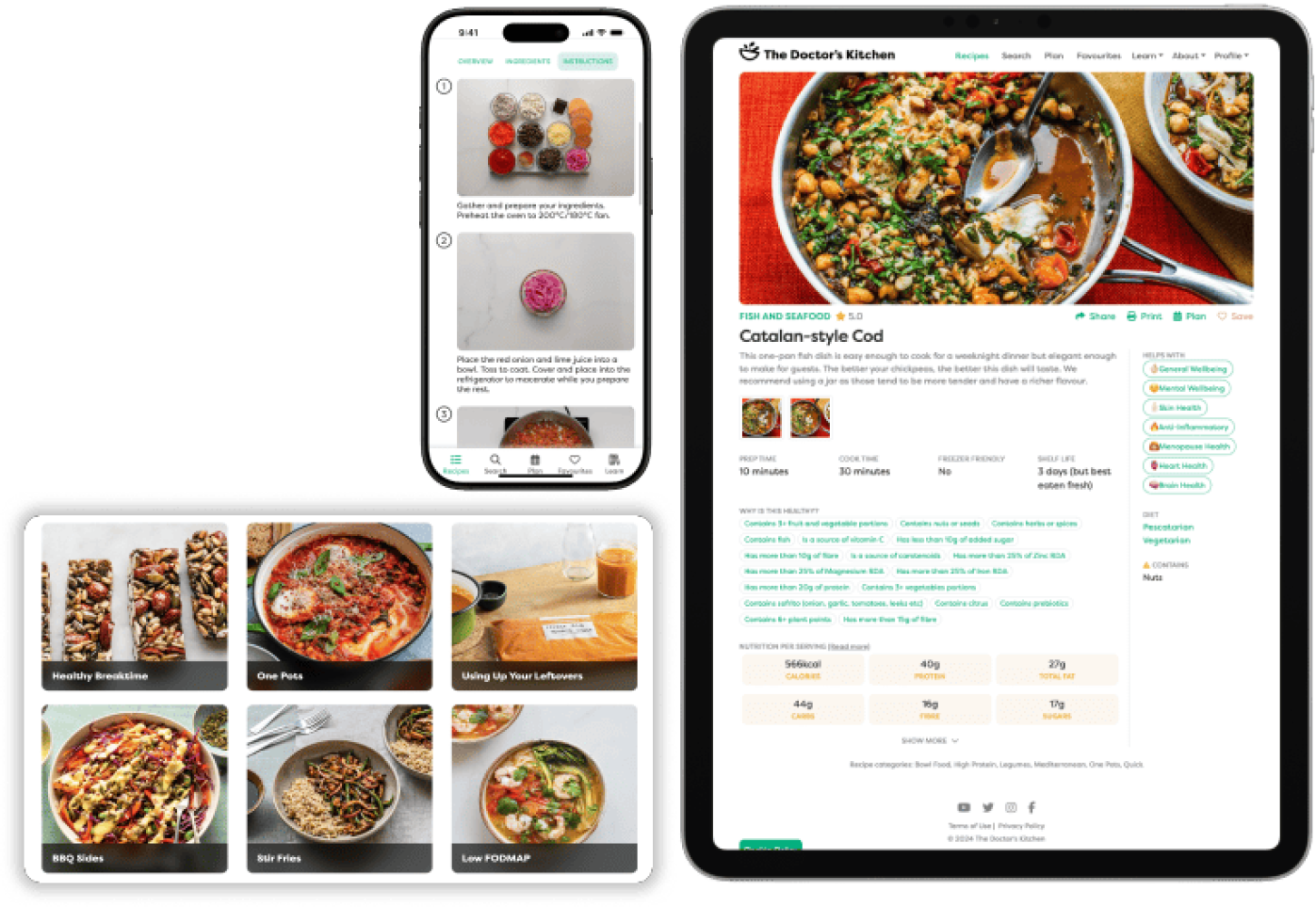
👉 Get all my go-to recipes in The Doctor’s Kitchen app and try it free for 7 days!
In this episode:
- The habits that help me make better choices wherever I am
- How to navigate confusing food labels and health claims
- Easy ways to support your energy, mood and gut health with food
- How to make healthy eating feel easier and more automatic
Start with just one!
- Access over 1000 research backed recipes
- Personalise food for your unique health needs
Available to new users joining a yearly plan only. Ends 30/11/2026.
Related content
-
Hot topicsListen
How to improve your mood, energy and brain health from breakfast to dinner | Professor Tim Spector
-
Hot topicsListen
4 food groups to lower inflammation, support your immune system and help you age well | Dr Jeffrey Bland
-
Hot topicsListen
The 3 macronutrients of happiness and how to build them into your life | Professor Arthur Brooks
-
Hot topicsListen
4 ways your thoughts affect your metabolism, gut and longevity | Sarah Ann Macklin
-
Hot topicsListen
Can ayurveda improve your health with food, herbs and daily routines? | Dr Vijay Murthy
-
Hot topicsListen
How to use your breath to sleep better, stress less and live longer | James Nestor
-
Hot topicsListen
#335 Saliva Tests, Poop Cameras, Digital Coaches and What the Future of Health Looks Like | Lara Lewington
-
Hot topicsListen
#334 The One Pesticide Everyone is Exposed To and Why It Should Be Banned | Prof Michael Antoniou
-
Hot topicsListen
#333 Why Muscle Is the Organ of Longevity | Dr Gabrielle Lyon
Podcast transcript
Dr Rupy: Now we are so easily tricked by front of pack messaging. High in protein, gluten free, one of your five a day, all sounds really attractive. But if I ran a supermarket for a day, I would literally turn every product around on the shelves so the back of pack with the nutritionals and the ingredients list was the first thing that everyone saw. And I reckon it would actually make a very good TV show. Whether it's cereal or granola or protein bars, bread, marinade sauces, dips, I always read the label first. And I want you to get used to doing some really quick maths. So I tend to ask myself a minimum of five questions. Number one, sugar per 100 grams. If it's a 5 grams of added sugar per 100 grams and I'm looking at a savoury product, that's fine. But if it's like 10 to 15 grams and this is a savoury product, this is way too much sugar. It should not be in a savoury product. And it also depends on how much of this product I'm intending on consuming. So dark chocolate, which if you're a regular listener or viewer of the show, you'll know that I'm a very big fan of, this will tend to have around 15 grams of added sugar depending on the percentage of cacao. So I tend to go for 85%, so the maximum amount that you're going to find of sugar is going to be 15 grams. I'm not going to be consuming 100 grams of that entire bar in one sitting. I might have 10 to 20 grams. So in that case, even though the sugar per 100 grams is higher than 5 grams, I'm not going to be consuming that much that I'm actually getting a high dose of sugar. So nuance is really important, but generally you want to be looking at less than 5 grams of added sugar per 100 grams of product.
Dr Rupy: The second thing is protein per 100 grams. Now, every meal, you want to be aiming for anywhere between 20 and 30 grams depending on what your needs are. And depending on whether this is a core protein that you're consuming or not, you want to be looking for at least 15 grams of protein per 100 grams of product. So if this is tempeh, that's a really good core protein because it tends to have around 20 grams per 100 grams. If you're looking at lean chicken breast, for example, again, that's around 25 to 30 grams per 100 grams of product. So if you're looking at a core protein as the packet or something that you're looking at, you want to be looking at that protein per 100 grams of around 15 grams plus.
Dr Rupy: The third thing is fibre per 100 grams. 8 grams plus is my go-to. And a good ingredient to look at is white pasta. So white pasta can be as low as 1 to 2 grams of fibre per 100 grams. There are some really interesting lentil-based pastas that can be upwards of 8 grams per 100 grams of fibre. So that's a really good swap there. But even some of the wholewheat or durum wheat pastas, they're around 4 to 5 grams of fibre per 100 grams. So they are all bumping your fibre amounts up. And you want to go for as much fibre as you can.
Dr Rupy: Fourth is, how many ingredients does this product have in the ingredients list? And is it appropriate for what I'm buying? So bread should only have three or four ingredients: flour, water, salt, maybe some yeast in it as well, not 15 plus. Chocolate, another example, should have three: cacao butter, a bit of sugar and cacao. It should not have a large ingredients list full of emulsifiers and stabilisers and other preservatives. And that's the fifth thing I'm looking out for. Are there these additives in the ingredients list that should not be there? And this is probably the most important thing for me as there is growing evidence, especially for emulsifiers like polysorbate 80 and something called CMC or carboxymethyl cellulose, that they can disrupt the gut microbiome balance and induce low-grade inflammation. So as a one-off, not bad, but if this is something that is consumed daily in your diet, this is definitely something to remove. And it's quite hard to tease out the impact of emulsifiers because sweeteners and these other products tend to be lumped together in ultra-processed products. And that's why I take the precautionary approach. I'm not waiting for like this big study and proper randomised control trials to show me that definitively these ingredients are harmful. I'm just going to avoid them from the get-go.
Dr Rupy: And even though I said I'm just looking at these five questions, I'm also pondering other things, like is there sugar in disguise? Apple juice, fruit purees, molasses, syrups, there are literally hundreds of names that sugar hides behind. And also fake sugars, so things like polyols and aspartame or sucralose. Would I even need any sweetener or sugar at all if I was making this product from scratch? And considering in the UK adults consume over 50% of their daily energy intake from ultra-processed foods, this is definitely a reflex worth learning and just trying to remove these additives that are completely unnecessary to human nutrition.
Dr Rupy: When you start pondering these questions, you also start thinking about something called the food matrix. So how the original ingredient has been reformulated and reshaped into something completely different that you would not recognise. So a whole grain being shaped into a powder or a syrup or a liquid. This has been so disruptive to the chemical bonds and the physical structure that it's going to change how your body reacts to it when you consume it. So a potato that's been extruded and made into a puff or an oat that's been turned into a syrup is going to behave very differently, completely differently in your body than the whole food that it came from when you consume it in its nature's intended format. So even with an identical ingredients list on paper, that food matrix, that format is something very, very important. I had this example of when me and my wife and my son were living in LA for a little while, she came home with these coconut chips and there were three ingredients that were proudly stated on the front of pack in these coconut-based chips. It was potato, coconut oil and salt. And so if you think of the questions I just asked you to think through when you flip the pack as your healthy eating reflex, you'd probably conclude, you know, this isn't bad. But if you just zoom out and actually think, okay, so this potato has been flattened and probably treated and then deep fried in a refined oil and then added salt, you know, it's then you start thinking, okay, this is still an ultra-processed product even though the ingredients list is pretty clean. So you have to think through these things with a bit of nuance and actually get used to, okay, what am I consuming? What is the intention that I'm consuming this in? Is it I'm recognising that this is like a little treat for myself, not something that I can proudly and confidently consume every single day as a health product, which a lot of these brands are tricking you into into thinking.
Dr Rupy: A serving size is another one that's very, very common. Like a lot of the cereal brands will shrink the serving size down to like 35 grams and then state the amount of sugar per 35 grams. My two-year-old would literally demolish a 35-gram serving of cereal in 30 seconds. You know, an adult is going to have way more than the suggested serving size of a lot of these products. So just watch out for that little sneaky hack that you find quite commonly in American products as well. So just don't be misled. These are just some of the questions that I'm pondering and there is a time and place for processed foods eaten with intention. My fear is that a lot of us are unintentionally consuming these products thinking that they're actually healthy. So be packet savvy and remember it's less about packets and it's more about eating whole foods as much as possible. So arm yourself with this reflex when you find yourself in a pickle in like, you know, the petrol station or a cafe and there are literally no whole foods to choose from, but remember it's all about getting whole foods as much as possible. So here are five of the simplest healthy eating reflexes I use pretty much every day, starting with flipping the pack.
Dr Rupy: I've developed these healthy eating reflexes over time that have helped me stay consistent with my eating habits. And this has led to me improving my energy, my gut health, even supporting my mood. And honestly, I wished more people learned these healthy eating reflexes because I believe it can help you navigate a complicated food environment and use food as medicine to live a healthier life. And that's exactly what this whole channel is all about. I've been a medical doctor for over 15 years. I'm also a nutritionist, and my core belief is what you put on your plate can be powerful medicine. And the whole reason why The Doctor's Kitchen exists is to help you feel in control of your health through food. So here are five of the simplest healthy eating reflexes I use pretty much every day, starting with flipping the pack.
Dr Rupy: Now, we are so easily tricked by front of pack messaging. High in protein, gluten free, one of your five a day, all sounds really attractive. But if I ran a supermarket for a day, I would literally turn every product around on the shelves so the back of pack with the nutritionals and the ingredients list was the first thing that everyone saw. And I reckon it would actually make a very good TV show. Whether it's cereal or granola or protein bars, bread, marinade sauces, dips, I always read the label first. And I want you to get used to doing some really quick maths. So I tend to ask myself a minimum of five questions. Number one, sugar per 100 grams. If it's a 5 grams of added sugar per 100 grams and I'm looking at a savoury product, that's fine. But if it's like 10 to 15 grams and this is a savoury product, this is not this is way too much sugar. It should not be in a savoury product. And it also depends on how much of this product I'm intending on consuming. So dark chocolate, which if you're a regular listener or viewer of the show, you'll know that I'm a very big fan of, this will tend to have around 15 grams of added sugar depending on the percentage of cacao. So I tend to go for 85%, so the maximum amount that you're going to find of sugar is going to be 15 grams. I'm not going to be consuming 100 grams of that entire bar in one sitting. I might have 10 to 20 grams. So in that case, even though the sugar per 100 grams is higher than 5 grams, I'm not going to be consuming that much that I'm actually getting a high dose of sugar. So nuance is really important, but generally you want to be looking at less than 5 grams of added sugar per 100 grams of product.
Dr Rupy: The third thing is fibre per 100 grams. 8 grams plus is my go-to. And a good ingredient to look at is white pasta. So white pasta can be as low as 1 to 2 grams of fibre per 100 grams. There are some really interesting lentil-based pastas that can be upwards of 8 grams per 100 grams of fibre. So that's a really good swap there. But even some of the wholewheat or durum wheat pastas, they're around 4 to 5 grams of fibre per 100 grams. So they are all bumping your fibre amounts up. And you want to go for as much fibre as you can. Fourth is, how many ingredients does this product have in the ingredients list? And is it appropriate for what I'm buying? So bread should only have three or four ingredients: flour, water, salt, maybe some yeast in it as well, not 15 plus. Chocolate, another example, should have three: cacao butter, a bit of sugar and cacao. It should not have a large ingredients list full of emulsifiers and stabilisers and other preservatives. And that's the fifth thing I'm looking out for. Are there these additives in the ingredients list that should not be there?
Dr Rupy: And even though I said I'm just looking at these five questions, I'm also pondering other things, like is there sugar in disguise? Apple juice, fruit purees, molasses, syrups, there are literally hundreds of names that sugar hides behind. And also fake sugars, so things like polyols and aspartame or sucralose. Would I even need any sweetener or sugar at all if I was making this product from scratch? When you start pondering these questions, you also start thinking about something called the food matrix. So how the original ingredient has been reformulated and reshaped into something completely different that you would not recognise. So a whole grain being shaped into a powder or a syrup or a liquid. This has been so disruptive to the chemical bonds and the physical structure that it's going to change how your body reacts to it when you consume it. So a potato that's been extruded and made into a puff or an oat that's been turned into a syrup is going to behave very differently, completely differently in your body than the whole food that it came from when you consume it in its nature's intended format. So even with an identical ingredients list on paper, that food matrix, that format is something very, very important. I had this example of when me and my wife and my son were living in LA for a little while, she came home with these coconut chips and there were three ingredients that were proudly stated on the front of pack in these coconut-based chips. It was potato, coconut oil and salt. And so if you think of the questions I just asked you to think through when you flip the pack as your healthy eating reflex, you'd probably conclude, you know, this isn't bad. But if you just zoom out and actually think, okay, so this potato has been flattened and probably treated and then deep fried in a refined oil and then added salt, you know, it's then you start thinking, okay, this is still an ultra-processed product even though the ingredients list is pretty clean. So you have to think through these things with a bit of nuance and actually get used to, okay, what am I consuming? What is the intention that I'm consuming this in? Is it I'm recognising that this is like a little treat for myself, not something that I can proudly and confidently consume every single day as a health product, which a lot of these brands are tricking you into into thinking.
Dr Rupy: A serving size is another one that's very, very common. Like a lot of the cereal brands will shrink the serving size down to like 35 grams and then state the amount of sugar per 35 grams. My two-year-old would literally demolish a 35-gram serving of cereal in 30 seconds. You know, an adult is going to have way more than the suggested serving size of a lot of these products. So just watch out for that little sneaky hack that you find quite commonly in American products as well. So just don't be misled. These are just some of the questions that I'm pondering and there is a time and place for processed foods eaten with intention. My fear is that a lot of us are unintentionally consuming these products thinking that they're actually healthy. So be packet savvy and remember it's less about packets and it's more about eating whole foods as much as possible. So arm yourself with this reflex when you find yourself in a pickle in like, you know, the petrol station or a cafe and there are literally no whole foods to choose from, but remember it's all about getting whole foods as much as possible.
Dr Rupy: And the second thing is getting a good dose of protein at breakfast. It is still very, very common to have hardly any protein at breakfast and save most of it for dinner. And I get it, most of the typical breakfast options are like toast and cereal and you just grab and go something on a busy morning. But adding protein can make such a difference to how you feel in terms of your cravings, feeling more focused, having steadier energy through to lunch. You're also giving yourself the signal that you are satiated, so you're less likely to go for those elevenses and the sort of snacks that you find at your workplace or at home. You're going to be giving your body the amino acids that it needs to maintain and repair muscle, which may have broken down overnight because you're literally coming out of a fasted state. And this becomes even more important as we age. And this is why I recommend people should be aiming for a minimum of 1.1 to 1.2 grams of protein per kilogram of ideal body weight. So ideal body weight is the important caveat here. So if you find yourself being quite overweight, 20 kilos overweight or 30 kilos overweight, you want to be thinking about the ideal body weight that you should be for your height and age and your activity levels. More is what I recommend if you're over the age of 50 or post-menopause. And we actually have a free protein calculator on The Doctor's Kitchen app if you want to check your own protein goal number. Now, my suggestion as a rule of thumb is to go for 20 to 30 grams of protein at breakfast. I personally aim for above 30 grams because of my weight and my fitness goals. But again, you can work it out for yourself. Loads of free protein calculators online, but think of that 1.1 to 1.2 grams per kilogram of ideal body weight as a good metric of something that is a safe foundation. And this does not need to look like bacon and eggs at every breakfast. It could be chia pudding. We've got a chia pudding recipe, a bunch of chia pudding recipes on YouTube right now, but chia pudding with Greek yoghurt, mixed seeds, fruit and nut butter. Phenomenal. Great source of core proteins. Greek yoghurt is a source of casein, slow-release amino acids over time. It's a wonderful start to your day and you haven't had to overthink it or cook anything and it can be as quick as cereals. Eggs with beans, greens, seeded whole grain toast, very simple, very quick, something that I tend to do at the weekends because I tend not to like to cook something in the morning when I'm rushing out the door. Oats, flax, hemp. I do overnight oats, there's some on The Doctor's Kitchen app as well. If you need it, a good quality unflavoured protein powder. I personally opt for a plant-based one that's a blend of rice, hemp and pea, and it's been third-party tested to be shown to be low in heavy metals and other contaminants. Again, you can find these apps, these recipes on The Doctor's Kitchen app. Or even leftovers, lentils, beans, fish from dinner the night before. Leftovers are absolutely breakfast food. There are no issues around having leftovers for breakfast. We need to get used to having leftovers for breakfast and breakfast can absolutely be savoury.
Dr Rupy: The trick is to prepare your breakfast the night before. That way when the morning gets chaotic, you're not caught with your pants down and, you know, just grabbing anything that you can. Boil a couple of eggs the night before, that can also be a great time saver in the morning. But make sure you build your meal around a core protein.
Dr Rupy: As an additional tip, at breakfast time, try and hydrate before you caffeinate. When you've slept for eight hours, lucky you, your body is thirsty and it's why the colour of your pee is a concentrated, darker yellow colour first thing in the morning. The last thing you need is an espresso shot to start your day. You want to hydrate as soon as possible. It's sort of more about the behaviour change and habit stacking and making sure that you're getting into the routine of making sure that you are hydrated first thing before you start your day because there used to be times, particularly when I was working as a hospital doctor, that I would leave the house and I wouldn't hydrate and then I would find myself like at 12 p.m. thinking, gosh, I have not passed any urine. And the funny thing is when you're working as a doctor, you're looking after patients, you're constantly asking yourself about the fluid status of those individuals, and then you recognise, oh my gosh, my fluid status is probably just as bad if not worse. So just drink and you don't need to add electrolytes to it. Don't overthink it. Plain, clean water could be cold or warm, you can have a little bit of lemon. This is actually something that my dad does. My dad's always had warm water with a little bit of salt and lemon. It's like an Ayurvedic tradition of like starting your day with something a little bit bitter to get things going. Very little evidence, but if it gets you into that routine of drinking water first thing, that's great. I personally have around 800 mils to 1,000 mils of water first thing. I know it sounds like a lot, it's over about 10 minutes, but you will not overhydrate yourself with this quantity of liquid. Try it for a week and see how you feel.
Dr Rupy: The third healthy reflex is getting a green side. Now, I am an absolute foodie. I love trying new restaurants. Right now, some of my favourites include Ducksoup in Soho, Gold in Notting Hill, the Hero pub in Maida Vale, brilliant pub, great homely British food. For Thai food lovers, there's Plaza Khao Gaeng, Plaza Khao Gaeng, I think it is, I'm probably pronouncing it incorrectly. Very, very spicy Thai food, phenomenal. They don't hold back on the spice. But I'm also the kind of person that will scan the menu and if they don't have a real good selection of greens on their sides, preferably some like cruciferous vegetables like kale, broccoli, tenderstem, that kind of thing. If not, and I'm comfortable admitting this now, I will make myself a small nutrient-dense, low-protein salad before I go out to eat in a restaurant, just so I know that I've hit my quota of nutrient-rich greens for that meal. And my wife, if she's listening to this, she's probably not, she'd be nodding along pretty vigorously right now because we'll literally be out just about to leave and I'll be there chomping down a green salad and she'll be looking at me pretty strangely. Terry Wahls, who is a medical doctor and a MS researcher, really inspired me to think more seriously about getting cruciferous vegetables in my diet. She's an incredible individual that overcame multiple sclerosis herself. Uh, is more of a paleo sort of persuasion, but she does not skimp on her greens. She's literally having three cups of cruciferous vegetables every single day, paired with like really rich, deeply coloured berries like aronia berries and blueberries. And I'm really committed to ensuring I get my fill of anti-inflammatory greens daily. As I think we all should be, because it is genuinely the cornerstone of many healthy diets, not just the Mediterranean diet, but you find it across different cuisines. So in Greek, hortā is like a selection of wild greens that's served with extra virgin olive oil and lemon and a little bit of salt on the side of a meal. In Italy, you have like a green chicory dish, it's called like repassata or something. In Egyptian and Levantine cuisines, you have like molokhia and hindbeh, and these are like a really richly, you could tell the nutrient density just from the taste of these sides, and that's got like more of a soupy texture, like particularly molokhia. Gomen in Ethiopian and Eritrean cuisines, saag from India. There are an abundant selection of different greens that you find in Chinese cuisines. Across the country, you have so many different regional specifics using bok choy, choy sum, gai lan, water spinach. You know, there's just so many ways in which we use greens across some of the healthiest ancestral cuisines. So really lean into that. Think about greens in your diet. And when we examine the literature, because obviously we're science-led here, around 100 grams a day increment is associated with a 10% lower risk of dying from all causes. But the benefits can start from as little as 20 to 50 grams a day. That's not even a full handful of like cooked spinach. That's it's, you know, literally reducing the risk of different cancers and all-cause mortality. So think about greens in a medicinal content, but you context, but you can also think about them from adding flavour to your meal as well. And if you've been listening to The Doctor's Kitchen for a long time and you want top marks, go for sprouts. So sprouts, rather than just Brussels sprouts, sprouting, so sprouting kale or broccoli sprouts, arugula sprouts or rocket sprouts, these contain markedly higher levels of something called glucosinolates and another isothiocyanates. A much higher amounts of polyphenols in general. And this may be part of the reason why greens are so important for cancer protection because they're that anti-inflammatory, they can protect your DNA. And these sprouted forms, particularly broccoli sprouts, have been studied to show greater concentrations of these anti-inflammatory chemicals than the mature vegetables themselves. So this is something, if again, if you wanted extra points, start sprouting yourself. We've had Doug Evans on the podcast, that's a big sprouting advocate. You can buy these little sprouters online, really cheap. I'm going to get into the habit of actually teaching Raf, my my son, how to sprout broccoli from scratch in three to five days. They're also rich sources of things like carotenoids, lutein, zeaxanthin, these are very important for reducing the risk of macular degeneration, vitamin K, that's also very important for bone health. So these are, you know, things to explore. There's a world of greens available to us and sprouting is just, you know, for for top marks. And if you want more marks, then chopping or chewing raw greens and letting, you know, those chemical sort of bloom or by adding a myrosinase source. So myrosinase is another chemical that can increase the conversion to the more potent forms of things like sulforaphane that you find in brassica vegetables. You can add mustard seeds to to broccoli or mustard seeds to kale. This increases that conversion and again, you get more of the bioavailability of these anti-inflammatory chemicals. So these are again, for top marks, but at the very base, you don't want to make it a chore. I don't want to to to for this to be a blocker. Just enjoy your greens however you want them, just get them in. Just remember, a meal isn't complete without a side of greens.
Dr Rupy: Just like a day isn't complete without your BBGs. Now, it's probably no surprise to a lot of people, my fourth healthy eating reflex is to remind myself as to whether I've hit my BBGs. Beans, berries, greens, seeds and nuts for the day. Now, greens are a single layer in the building blocks of fruit and vegetables that you want in your daily diet. And we want to be aiming for 800 grams per day if you want top marks. So when we look at studies, there appears to be what's called a non-linear effect of protection against things like cancer, cardiovascular disease and all-cause mortality at 800 grams. So, you know, in an ideal scenario, we'd all be having a rich variety of different fruits and vegetables totalling 800 grams per day. It sounds a lot, but when you think about it and you just think about it through the context of meals and snacks, it's having two to three portions every meal. And it's very easy to build your meals around that with recipes that we, I mean, this is literally the inspiration behind building The Doctor's Kitchen app in its in the first place because we're building meals around the evidence around how much fruit and vegetables you should be consuming at every meal time. But we also want a variety of sources too. So my healthy eating reflex is at the end of each day, I ask myself, did I hit all my BBGs today? Beans, berries, greens and seeds and nuts. I throw I throw nuts in there as well. It's the single easiest hack or heuristic that I give my friends and families and patients and one that I personally live by myself. So going from the top, a handful of cooked legumes, it could be beans, it could be lentils, doesn't matter, a large handful of cooked beans and lentils. A handful of berries, fresh or frozen. Don't let anyone tell you that frozen doesn't count. Fresh or frozen, perfectly fine. I try and go for the darker coloured berries. A decent handful of greens. This is a minimum and this is why I always think, you know, a meal should always have a green on the side, but a decent handful of greens every day is a minimum. And I always look for a handful of nuts or seeds or a mixture scattered into whatever I'm eating or simply eaten as a snack. So why are these four things so important? So thinking about beans, because I know this can be a source of contention with a lot of people that can't tolerate a lot of fibre from beans. Legumes are one of the largest contributors to life expectancy gains when we look at nutrition studies. So nutrition studies have a lot of issues, observational nature, a lot of cohorts, a lot of confounders, a lot of people who do healthy eating habits also have healthy eating lifestyle or a healthier lifestyle. So they exercise, they don't smoke, they don't eat processed foods, etc, etc. But when you look at these nutrition studies, just having some beans in your diet regularly every day is estimated at adding two to two and a half years when optimised from a typical low-fibre Western diet. We simply do not eat enough of these fibre-rich ingredients. And when you break down the potential reasons as to why legumes are so good, not only do they contain soluble fibre, but they contain polyphenols and saponins and their fermentation byproducts as a result of the gut microbes breaking them down are locally anti-inflammatory. They can reduce cholesterol, they can improve your glycemic levels, so your blood sugar level. And it can be from as little as 400 grams a week, or that's about 50 to 60 grams a day. That's all you need to get started. I personally try and aim for more, but that's because I've trained my gut to tolerate beans at a higher level. And this is a very important part. I was actually speaking to a family member last week about how they can't tolerate any sort of beans. Whenever they have beans and, you know, the side of curry or chickpeas or whatever, they get bloated and that's why they stay clear of it. And I analysed their diet and I realised they really do not have that much fibre. They eat really well, they eat a calorie-controlled diet that's high in protein. So they're they're ticking some boxes, but they're really lacking in fibre. So it's no wonder, it's very obvious to me that when you have a side of chickpeas, of course you're going to get bloated. Your microbes have got no idea what to do with this nutrient-rich ingredient because they're not used to dealing with this on a daily basis. And so if you are, when you analyse your diet and you realise you don't have any legumes in your diet, you want to go really, really slow. And we've spoken about this with Dr Emily Leeming on the podcast before, where she will literally suggest having a tablespoon of beans, washed, cooked from the can or cooked from from a can or cooked fresh, wash them and then have that once per day just to gently titrate up the dose over a period of weeks before you start increasing that dose every single day, just to get your microbes used to having this fibre-rich ingredient in your diet. Obviously, if you have IBS or you're intolerant to FODMAPs, I would definitely speak to a dietitian and get some personalised support. But as a very minimum, you could try and do this yourself, as long as you don't have any allergies to legumes, just trying to introduce these fibre-rich ingredients into your diet. You don't need to start really high. It's the equivalent of like going to the gym for the first time and trying to deadlift your own body weight. You're going to feel very, very sore. In the same way, your microbes are going to have a bit of an insult and a lot of work to do, which is why you produce a lot of gas and you can produce bloating and it can be very, very uncomfortable. So really think about this strategically and think about aiming for 400 grams a week, but starting really, really slow.
Dr Rupy: Berries on the other hand, any regular consumption is beneficial. They contain flavonoids and anthocyanins, which are the largest category of polyphenols of which there are thousands of these different chemicals and they have positive effects on your gut microbiome and direct anti-inflammatory effects. They also provide fibre and their secondary metabolites that aren't as well studied themselves but are super interesting. I remember learning a lot about this when I was doing my master's in nutrition. These secondary metabolites, so when you have an anthocyanin and your your microbe digests it, it turns it into another chemical, and then that chemical might have a local effect and then, you know, it has this cascade impact on the rest of your gut microbiota, which is phenomenally complex and interesting. But the take-home message is we should all be getting berries into our diet as much as possible. And you've got so much selection, so many different types of berries. I've been doing a lot of research into the highest polyphenol berries. You've got things like chokeberry and elderberry that need to be cooked. You've got aronia berry, which is relatively hard to come across. But you also have things like blackcurrants in the UK that are the highest in anthocyanins. Blueberries have probably got the best marketing, the best PR team behind them, but blackcurrants, the stuff that you find in Ribena, I'm not suggesting you drink Ribena, but the the same stuff that Ribena is based on, blackcurrants in the UK that have a bitter, more of a bitter flavour, so they're less attractive. But that bitterness is a feature, not a bug. You want to be going for those bitter berries because that is indicative of the density of those polyphenols. So these are the things you want to be having a handful of every single day.
Dr Rupy: Greens, I'm not going to talk about anymore. It should be really obvious as to what kind of greens you should be having, why you should be having greens. Nuts are probably one of the the single best contributors to heart health that you can do every single day. A small handful is all you need with the strongest risk reduction at 28 grams per day. This can lead to 22% lower risk of all-cause mortality. And there was a really cool modelling study that actually estimated that adding a handful of nuts daily from age 20 could add another up to two years of life expectancy. So if you've got young kids, or you're a 20-year-old or 30-year-old in your life, get them eating nuts every single day, as long as they don't have allergies, obviously, but get them eating nuts and seeds every single day. Rich sources of vitamin E, magnesium, zinc, all things that tend to be lacking in our diet. And also these specific fats that can be beneficial from a cholesterol perspective as well. It has this cholesterol-lowering effect and it also has fibre and protein as well. Snack on them, add them to salads, pair them with delicious dark chocolate. I sometimes, I learned this trick actually from going to Berenjak recently, another London restaurant that I absolutely love. Very meat-heavy, but I remember ordering the sides, I was trying to get my green side, and I noticed they were finely grating walnuts on top of their, it was sort of like a hummus, but it was using a different legume. Finely grating walnuts on the top as a garnish. Amazing hack. It just has this butteriness, this wonderful flavour. You want to do it fresh because that way, what you're doing when you're finely grating something is that you're increasing the surface area of the product. So you're exposing a lot more air to it. So it blooms the flavour and it makes it so much more enjoyable, but you want to do it right there before you eat it rather than like a couple of hours before. So if you've ever grated ginger fresh, super pungent. If you grate ginger and leave it on your chopping board and then eat it, markedly lower gingery-ness, less sort of fire in the flavour, which is why I'm not a big fan of ginger shots because they've grated it, added it to water and it's just sat there on a shelf in a warm sort of Pret a Manger or whatever for days at a time and it's just sat there like losing its antioxidant potency. So you want to do it fresh, you want to just add some water to it. So, sorry, I'm going on loads of different tangents here, but my my point is you can experiment with using nuts and seeds in interesting ways if you think just having a handful of it is boring. Again, on The Doctor's Kitchen app and the website, we've got tons of different recipes for you to explore. These are some of the cheapest and most accessible ingredients in any supermarket. And the evidence behind these BBGs, great for your gut, great for your heart, great for your brain, great for your long-term risk of disease. It's just enormous. So you don't need to hit all four every single day, but if you get into the habit of asking yourself, did I hit my BBGs today? You're doing marvellously. And you can just work on one at a time. So if you just want to work on berries, make sure you hit your berries every single day. And like I said at the start, I always think every meal, I think three. Am I getting a good diversity of colours? Ideally a bean, a nut, and a colourful veg. That's all it takes. A bean, a nut, and a colourful veg. And this is literally how I build my own meals as well.
Dr Rupy: And the fifth thing, this is something that I'm leaning into a lot more these days. My fifth healthy eating reflex is becoming a polyphenol person. Polyphenols are the plant compounds that are responsible for the colour, the bitterness, the astringency that you taste in fruit, vegetables, herbs and spices. So the purple of the uh, the that dark red in blueberries, the bitterness of dark chocolate, the punch of turmeric. There are literally thousands of different types, mostly classed into flavonoids, which is the biggest class, phenolic acids, lignans, stilbenes, where you find resveratrol, and other polyphenols that are more specific to certain ingredients like curcuminoids that you find in turmeric. Some popular ones include resveratrol in red wine, anthocyanins in berries, SDG in flaxseed, and each one seems to do something different for our gut and uniquely marvellous. They have just are blooming in terms of like the amount of research looking at these different chemicals. And the aim of the game is to try and get as much variety as possible. So whilst I try and aim for 800 grams of fruits and vegetables a day, I'm also mindful of reaching for a very wide variety of deeply coloured fruit, vegetables, berries, onions, chicory, chard, carrots, all that kind of stuff. But I think we miss a huge opportunity to hit the variety of polyphenols if we only think about it in terms of what's on our plate and not is what not what's in our glass. So in fact, coffee is one of the biggest contributors of polyphenols to diets, particularly from from those from the states. It might be a bit more reflective of the fact that a lot of us aren't having enough fruit and vegetables in our diet overall, but it's interesting nonetheless. And I think it's because coffee, again, like like many other polyphenol drinks that we'll talk about in a second, are just so richly concentrated in phenolic acids. I'm not going to try and convince you that you should be drinking red wine. I think that's a complete fallacy. Thankfully, there are loads of other ways in which you can enjoy polyphenols without the catastrophic consequences of regular alcohol intake that we should be steering really, really clear of. Green tea, hibiscus tea, rooibos, a strong espresso after you've hydrated first thing in the morning, a splash of 100% pomegranate juice in sparkling water. These all count towards your daily polyphenol variety. So make two or three of your daily drinks a polyphenol-rich one. One thing that I've started doing more in my own life is actually cold brewing teas. So there's a Turkish tea blend, I don't have any affiliation with this brand, they're called Mumco, M U M C U or C O, something like that. And they have a whole bunch of different blends. They've got sage, they've got like mountain tea, they've got all these, there's one, I think it's called the Turkish tea love, like love tea or something like that. And it's got citrus peel in, rose, pomegranate and hibiscus, all dried. And I simply put that into my cold brew filter, so it's a stainless steel filter that you buy on Amazon, and you dunk it into tepid water, you leave it on your counter for 12, 16, 24 hours, and then you take the steeping tea, dried tea herbs, all that kind of stuff out, and then pop it in your fridge. And you've got something that literally tastes like I've put sugar in it, because those, the rose and the hibiscus and the pomegranate, just these flavours come out and you you start to begin to experience and appreciate those the subtle sweetness in in whole foods without the sort of the need to mask it with actual refined sugar. It's wonderful. And I, you know, I'm trying to become a more more of a polyphenol person myself. And some recent evidence from a study that showed that diets reflecting a high variety of polyphenol foods was more strongly associated with lower cardiovascular risk than either total polyphenol intake or a single food source. So what this says to me is that it's not just about getting like one superfood in your diet, like a whole load of pomegranates and like drinking pomegranates every single day or having loads of matcha in your diet every single day and having matcha, matcha, matcha. It's about getting that variety. So really just mix it up. Just try and get matcha one day, hibiscus another day, cacao drink. My cacao drink is like a go-to right now, particularly as we're going into autumn. I have raw cacao, pinch of cinnamon, pinch of turmeric, some nutmeg, a little bit of raw honey, hot water, maybe some coconut cream if I'm feeling like I need something a little bit more luxurious at the end of the day. And I'm literally flooding myself with these flavonols that we know can improve your brain health, can improve your cardiovascular health, and I'm giving myself that rich diversity of polyphenols. So you want to maximise different polyphenol-rich foods and beverages consumed regularly rather than just loading up on a single superfood or single supplement. So think about these five healthy eating reflexes. Think about which ones you want to put into your own diet. There are obviously loads more that we can actually talk about, but start really, really small and these ripples of change hopefully will not only ripple through your life, but also the people that you love as well. And if you want to try some of these recipes that I talked about, you can find us on The Doctor's Kitchen YouTube channel, we've got loads of recipes there. And also The Doctor's Kitchen app is an incredible resource for so many of you. We literally get emails every single day about how flavourful the meals are, how easy they are. We've got one pans, one pot section, we've got a no-chop section that we're trying to build on at the moment because we want to make it as easy for you to feel in control of your health through food. That's exactly why we do what we do at The Doctor's Kitchen. Appreciate you. I will see you next time on the podcast and stay healthy, stay well.