How to improve your mood, energy and brain health from breakfast to dinner | Professor Tim Spector
4th Nov 2026
Every time you cook a meal, you could be shaping your mood, energy and how clearly you think, as well as supporting your long-term brain health. In this episode, we explore the links between diet, gut microbes, inflammation and brain health with Professor Tim Spector.
And we get really foodie, talking through a day of eating, from his go-to breakfast to easy midweek dinners.
Professor Spector is Professor of Genetic Epidemiology at King’s College London, a pioneering gut microbiome researcher, scientific co-founder of ZOE and bestselling author. His new cookbook, Good Mood Food, explores how what we eat shapes how we feel, think and age.
We cover:
- How inflammation and the gut–brain connection may influence your mood
- Blood sugar, brain fog and the debate around glucose spikes
- Tim’s yoghurt and kefir breakfast bowl, with berries, nuts and seeds
- What to look for when buying kefir
- Easy lunches
- Oily fish, omega-3s and ways to use sardines, anchovies and mackerel
- Adding more plants and fermented foods to your everyday dinners
- A two-week breakfast challenge and how to track how you feel
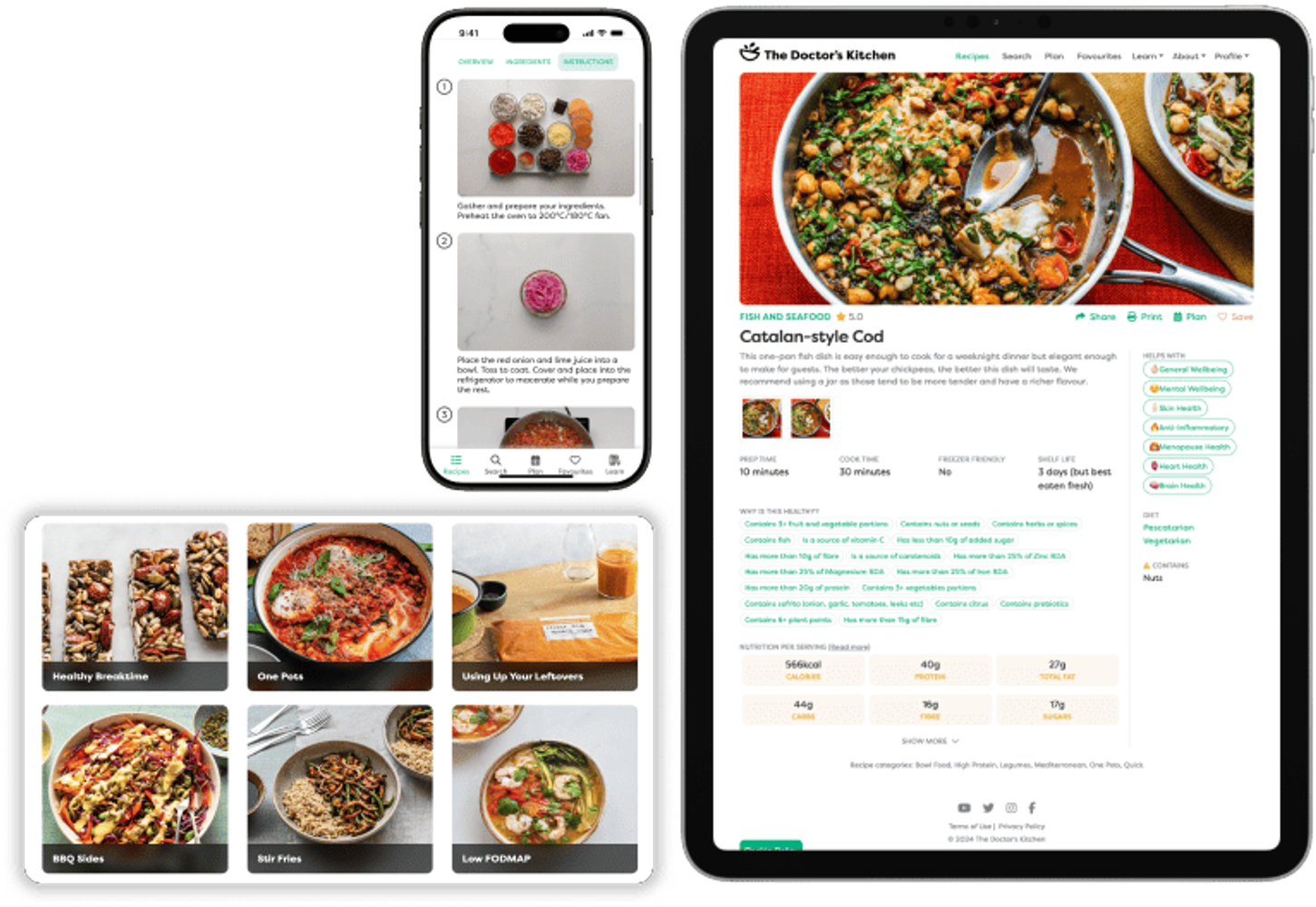
📌 Turn these ideas into delicious meals with The Doctor’s Kitchen app.
Episode guests
TIM SPECTOR, MD, is Professor of Epidemiology at King’s College London and one of the world’s leading scientists. He is the bestselling author of The Diet Myth, Spoon-Fed, Food for Life, The Food for Life Cookbook and Ferment, and scientific co-founder of ZOE, the gut health company. A pioneer of microbiome research, he is among the top 100 most cited scientists in the world and was awarded an OBE for his contributions during the COVID-19 pandemic. His Channel 4 documentary series What Not to Eat (January 2026) achieved record viewing figures with more TV to come.
- Access over 1000 research backed recipes
- Personalise food for your unique health needs
Related content
-
Hot topicsListen
4 food groups to lower inflammation, support your immune system and help you age well | Dr Jeffrey Bland
-
Hot topicsListen
The 3 macronutrients of happiness and how to build them into your life | Professor Arthur Brooks
-
Hot topicsListen
4 ways your thoughts affect your metabolism, gut and longevity | Sarah Ann Macklin
-
Hot topicsListen
Can ayurveda improve your health with food, herbs and daily routines? | Dr Vijay Murthy
-
Hot topicsListen
How to use your breath to sleep better, stress less and live longer | James Nestor
-
Hot topicsListen
#335 Saliva Tests, Poop Cameras, Digital Coaches and What the Future of Health Looks Like | Lara Lewington
-
Hot topicsListen
#334 The One Pesticide Everyone is Exposed To and Why It Should Be Banned | Prof Michael Antoniou
-
Hot topicsListen
#333 Why Muscle Is the Organ of Longevity | Dr Gabrielle Lyon
-
Hot topicsListen
#332 How Eating Local, Organic food Is Best for Environmental Health | Mallika Basu
Podcast transcript
Dr Rupy: Professor Tim Spector, mental health conditions account for the largest burden of disease globally. Can what we eat meaningfully change how we feel in our mood, our energy and our mental clarity?
Professor Tim Spector: Absolutely, yes. That's why I wrote the book, is to tell everyone, give everyone this message of how important food is for our brain. Because most people associate food with the size of their belly or their bottom. They don't really think of the link with the brain and virtually every mental health disorder and also neurodegenerative disorders like dementia and Parkinson's. When I started researching this two or three years ago, I didn't really appreciate how strong those links were. In the last few years, the thing that's really changed my mind about it have actually been some of the Zoe research studies where we've asked people to self-report how they feel, how their mood's changing and what their energy and fatigue levels are like on a daily or weekly basis. And all three trials we've done, whether it's studying the original Zoe product, the sort of testing, personalisation and gut health plan, whether it was going on fermented foods, whether it was taking the daily 30 prebiotic, within two weeks, the majority of people had reported an improvement in their mood and their energy fatigue levels. And we weren't expecting that. It was added on as a bit of a side thought because, as you know, it's not something doctors are taught to ask. For a GP, it's like the worst thing you can possibly ask a patient is to say, tell me about your energy levels, because they know they'll never get them out of the consulting room. So we were always taught self-reported stuff from patients is pretty worthless. When you've got this sort of daily idea of filling in an electronic way of sensing how you're feeling, then I think it you start to see the amazing links between that and how your gut health is changing and how the food you're putting into your body. And I think this is a real new insight that most doctors don't know and certainly the public don't really realise. And I think as we're getting these tools, we're suddenly be able given another way of listening to our bodies. So it hasn't really been an easy way of doing that before. You know, it's very well say, well just monitor your mood and your energy levels and tell us, you couldn't do it really, could you? So well, I'm a bit better and a bit worse. But you start to have, if you're scoring things out of 10 and you just score it every day in an app, I think it can be game-changing. You suddenly realise the effect that things like food can have on your day-to-day energy levels and your mood. And that I think is is one of the key messages I want to get across is so many people are on poor diets and we saw this in the TV series, you know, what not to eat. Every one of those families who were struggling with poor foods complained of tiredness. They were taking naps in the afternoon, they weren't sleeping well, they just constantly felt exhausted without knowing why. And they just say, well, it must be because I'm not fit, or it must be because I, you know, I don't go to the gym enough or blaming something, but they never thought it was anything to do with the food they were eating. And to me that was really important. So all these things came together at once and that's really when I said I've got to write a book about it. And the most accessible way to do it, as you know, is a cookbook. Because it's got lots of nice pictures, cheers you up, and you know, you can there's a, you know, a lengthy introduction, but it's still you don't have to read a whole science book to get it. And and the recipes do tell people what you need to do, what, you know, what are the actual examples on how you can change what you're eating. So I think that that really was what got me going as well, you know, and at the same time, I'm looking after my mum who unfortunately eight years ago had a stroke and developed dementia and has been in a home since. And you know, I wish, you know, I could have given her advice earlier to say how to how do you prevent that. And you know, we're in this massive pandemic of depression, anxiety, ADHD and and dementia with estimates that if you're in your 50s now, you've got a 40% chance of getting dementia before you die, which is pretty frightening and should make us all focus on what are the things we can do to reduce those odds or delay it.
Dr Rupy: Absolutely. Yeah. I I agree with the citizen science and the objectivity that apps can bring to some of the self-reported these self-reported studies. Something that we do within the Doctor's Kitchen app, we ask people after using the app for like 30 days or so, like how do they feel improvements in energy, something around 80 to 85% of people who cook three or more of our Doctor's Kitchen meals from the app feel better. And some of the biological routes as to why this might be occurring are things that you talked about in your your book. So when people hear this, you know, what I eat can have an impact on my mood, what are the main biological routes that people should be aware of? Like, why is it that diet can have this significant impact on mood, energy and our brain health?
Professor Tim Spector: I think the the number one concept people need to understand is inflammation. So inflammation is it's a natural process that we we all have it and it's very useful when we get infected or we have an injury. So it's an activation of our immune system to help defend us against microbes or tissue damage. And you normally get a spike in inflammation when that happens and then it goes back to normal. What's happening at the moment in in the modern world is we've all got levels of inflammation higher than our ancestors had. And in people who are eating terrible diets full of ultra-processed food, those levels are even higher. And it doesn't go back to normal. So what's happening is the body is in a state of heightened excitement and alert so that it's not the immune system doesn't then function as well as it should be. And in the brain, where we didn't until recently think there was an immune system, we now know there are immune cells in the brain and they are transmitting signals to the brain that all is not well and that the brain needs to react appropriately to that inflammation and then the brain will send signals to the body to say, okay, it looks like we're sick. Let's send signals to the muscles to our general behaviour to avoid other people, be anti-social because you don't want to pass on infections. You want to do as little exercise as possible because you want to conserve energy, so you stay under the duvet. And you want to prioritise, you know, conserving all your energy, so you're not interested in food or sex or enjoyment or having a laugh. So once you list those, you say, well, that that's really depression. So in a way, understanding that depression is very closely linked to inflammation starts you to to understand how these processes work. So that's the number one thing and food is a key driver of inflammation, not the only one. So there's, you know, life stresses and a lot of the risk factors for mental health disease are are similar, but inflammation is probably the key one we all need to know much more about.
Dr Rupy: Yeah. And I guess in terms of the evidence for some of these biological mechanisms, this appears to have the most robust set of studies with human randomized control trials, right, looking at an anti-inflammatory diet or something that can reduce markers of inflammation like CRP.
Professor Tim Spector: Yes, I mean, there's a whole range of of data on this. Obviously, there aren't long-term studies. We're talking short-term studies, but there's pharmaceutical studies of people with depression where they've given them strong anti-inflammatory drugs, for example. If anyone listening knows about autoimmune diseases, you've got these anti-TNF drugs used in things like rheumatoid arthritis. Give those drugs, within a few days, people's mood has bounced back amazingly. They've done randomized trials against placebo using some of these drugs and in about a quarter of cases, they can get remission of of depression. And it works better in people who have high blood levels of inflammation. And then you've got gut-friendly anti-inflammatory diets used in depressed patients like in the SMILES trial, showed that you got remission rates, people are basically sort of seen as cured, which are much higher than with traditional antidepressant drugs. So, and then you've got countless animal studies as well showing how you can switch anxiety, mainly is what you see in animals, anxiety on and off by switching out their microbes or changing their food or giving them antibiotics. So I think the evidence is building. We don't have all the answers, but there's certainly a big shift also in neuroscience between what we did think 10 years ago when we were convinced all these diseases were due to a deficiency in a neurochemical to the current idea now that that doesn't seem to be tenable. And we've been doing that for 50 years and it hasn't worked. We need a new holistic approach. So I think we just got to take a step back from all these mental health problems which I believe are probably, you know, a spectrum of the same disorder because they're all linked, whether you're talking about depression, dementia, schizophrenia, ADHD, autism, they've all got commonalities. And we shouldn't be seeing them as 350 separate conditions that all have a all can be explained by some rare neurochemical deficiency, which is what the drug companies have wanted us to believe for the last 50 years and that's that's dominated psychiatry. So inflammation, yes, is the is the key one. The next is obviously to understand the gut-brain connection.
Dr Rupy: Just on the inflammation note, it kind of works the other way as well, right? So you you've got some people with raised levels of inflammation and then you can reduce it with like TNF alpha inhibitors. But then there's also some other studies where they actually induce inflammation and that causes some of the similar symptoms of depression, low mood, some of the the sickness behaviours that you you mentioned earlier, which I I find fascinating because it works in both ways, so it gives even more sort of robust evidence for for the biological plausibility.
Professor Tim Spector: Yeah, and I used to be a consultant rheumatologist and you see countless patients with rheumatoid arthritis, which is one of the commonest autoimmune conditions. And 50% of my patients were depressed. And we always thought it was due to the arthritis. And you know, and we're told to pretty much dismiss it. Oh well, you know, they're upset because their joints hurt. And it wasn't that at all. It was because there was a common mechanism causing the immune system to malfunction and the same system was causing the brain to malfunction and send the signals of particularly fatigue, etc. So, you know, one of the cardinal features of rheumatoid arthritis is is fatigue, but also depression. We never put them together. So, you know, we let down a lot of those patients because we we were taking a much more super specialist view of of those conditions, which I think we can rectify now and treat it holistically. But it, you know, it's about bringing the brain also back into medicine. As you know, we've we've always treated psychiatry as a completely separate area. They only deal with symptoms, they never deal with signs or scans or biopsies. And they've been excluded from knowing about anything, you know, any of the advances in medicine or anything else. And it it's really doesn't make any sense to to have the brain as a completely separate area that doesn't understand the rest of the body because, you know, mental health problems in my view are, you know, are a whole body problem.
Dr Rupy: Absolutely. Yeah. And I guess, you know, on the subject of bringing the brain back into psychiatry, we should also bring the gut back into general medicine as well. That's been largely forgotten. And you were you were just about to talk about the the the gut-brain connection.
Professor Tim Spector: Yeah, so I think the other insight I've gained is that I, like most people, used to think the brain controlled the gut mainly. And you know, we've all been through exam day and you know, it's sending signals to your gut, you're definitely not hungry and you're definitely running to the toilet more than you were before. And you get butterflies in your stomach and it, you know, it's your brain telling your gut what to do. But the latest studies show that the gut-brain connection, which is mainly through the vagus nerve, which is like this internet super highway that connects the two, and you know, it's about half a meter long, it's the longest nerve in the body, is actually most of the signal, 80% of it is going from gut to brain rather than the other way around. So it is a two-way traffic, but essentially the brain is getting its information about how it should react from the gut as one of the central sources of its understanding the environment because you you got to conceptualize, you know, if you think of yourself as a brain, you're in a dark little cave surrounded by bone and you've got, you know, you've got to receive signals from everywhere to work out what's going on and all your job is to translate those signals into some idea of reality and then then, you know, send those signals back to Rupy to tell him what, you know, but he's got to you've got to be guessing all the time. You haven't got time to wait for the signals, you've got to predict it in advance. And that's that's really the fascinating new neuroscience. So the brain is acting as this prediction machine, which is is really exciting. And what it means is these signals are coming from the gut to the brain. So the bad food goes in, gut microbes react, they send out inflammatory chemicals, the immune cells and the microbes then send signals up the and the nervous system what send signals up the vagus nerve. We don't know exactly how it works. And then that goes to the brain and then it will then alter its predictions of reality. And that is really important. There's interesting studies showing that if you cut the vagus nerve, you know, you can reduce a number of mental health conditions. We used to cut the vagus nerve thinking it helped duodenal ulcers. What it helped was surgeon's bank accounts. But it did have other interesting consequences. So, yeah, the gut gut-brain axis really important and we're learning much more about it than we knew 10 years ago and the idea that the gut is a signaling device for the brain, I think is a is a new concept. So that, you know, makes should make you think every time you put something into your mouth that it's going to be a clue to the brain about what life is like outside the skull.
Dr Rupy: In terms of, I mean, we'll talk about foods in in more specifically in a second, but what is actually going on in the gut that can communicate to the brain that things are okay and have that sort of desired effect on on mood and mental health?
Professor Tim Spector: So a variety of things going on. The easiest one to sort of understand, I think, is your microbes will break down fibre. So if you're eating fibre, they will produce short chain fatty acids. And these are these very small molecules, potentially building blocks of of fat that will then interact and send signals to the immune cells lining your gut. And they will tickle those immune cells to send, you know, generally happy signals and then they will then pass up through the vagus nerve and then the immune cells in the brain, the microglial cells will then pick that up and transmit that through all the connections in the brain. That's one way. Then then you've got pro-inflammatory signals that you might get when you say have a leaky gut, you might changes in the pH, subtle change of the pH will allow certain microbes to flourish and they might send their own signals, harmful signals of pro-inflammatory signals that will again tickle the immune cells, most of them of which are in our gut anyway. So it all starts to make sense about why evolution and we evolved this, you know, everything is around our gut and why our nervous system first starts around our gut. You know, it's called our second brain because it's also there. So it's both a combination of the nerves and the immune and immune system both sending signals up to the brain.
Dr Rupy: In terms of like how established the science is between the the gut-brain explanation for mood versus the anti-inflammatory diet, would you say that this is lower in the order in terms of like the emerging science of looking at the gut-brain connection?
Professor Tim Spector: I think it's easier to do experiments on animals and work out how which direction things things go and what's happening to immune cells, so working out potential mechanisms than it is to study, you know, anti-inflammatory diets in humans. And it's also much cheaper. And you're much more likely to get a, you know, a high-ranking paper than if you spend your time doing a massive clinical trial of anti-inflammatory diets, which is why there aren't many. And governments are not pushing it. So, yeah, we have so I think that's probably why, you know, the clinical data is lagging actually the neuroscience and we have to sort of piece it together. But you know, I've been studying this now for two years quite seriously and you know, all the pieces are beginning to fit. Yeah, I'd like some more clinical studies. But everything is suiting that fitting this new paradigm, really.
Dr Rupy: So eating in a way that is broadly anti-inflammatory, i.e. a Mediterranean style diet, making sure that you're aware of the impact of what you put into your gut, what's great for your gut is also good for your brain. I guess another thing that's related to those two concepts is sugar. This is a big problem in the UK and the US, it's becoming a global phenomenon. How does a high sugar or high glycemic diet impact our our mood?
Professor Tim Spector: Great question. So I mean, I I personally noticed this in the early days of Zoe, we were testing our test muffins. So we used to give out these blue muffins for people and 300,000 people actually know what I'm talking about because they they ate them. And we recorded their blood sugar levels after it. And we, myself and 10 other volunteers for 24 hours only ate these muffins just every six hours. And recorded our what was going on in our our
Dr Rupy: I remember you sent me one of these kits as well and I remember thinking, gosh, this is terrible. 24 hours of these bloody muffins.
Professor Tim Spector: You didn't have to eat it for 24 hours. It was just it was a couple of meals. But I I did it one level up, right? So I eaten no other food. Just these things. And my blood sugar went all over the place. It was like, you know, it was like the Alps. And up and down. And I also noticed how it gave me brain fog. A concept which I didn't really believe until I experienced it. I was trying to work on on a book at the time and I just couldn't concentrate. And I found it really disturbing to be having these massive changes in my blood sugar. So that was the first I noticed of it and there are other studies showing that sugar can be a problem. It's still controversial in kids, for example, about whether it's the sugars or the additives in in food that can affect behaviour, but it seems to be some some children are predisposed to it. Turns out I'm quite sensitive to glucose. I've got all the wrong diabetes genes. I am very sensitive. And but what we do know is that type two diabetes, which is when you had sort of a permanent strain on your your insulin levels that leads to a permanent resistance to insulin, so you need more glucose, is linked to all the brain disorders. Every single one. Generally doubling your your chance of having one of them. And it's even stronger in, you know, in patients. So there's this clear link between having bad sugar control and brain disorders. Having one-off spikes, maybe here or there, but if they're much more continuous, it's probably a continuum and pre-diabetes, which is the stage before, is is also linked but just to a lesser level. And we think this is the current understanding is it's related to mitochondrial problems in the brain. So I didn't know this, but each cell has hundreds of mitochondria in it. And they have a much more active role than we were taught. They're not just batteries. They're actually controlling things like the immune system and they can move around the cell, they can send out chemicals, they can do all kinds of magic things that we didn't know possible. And this is all very new new science. So what we think is happening is that if the sugar levels go up, the mitochondria, which are key for keeping the brain's energy levels constant, start getting disrupted and sending out inflammatory signals and that as well as damaging themselves, they're also causing more inflammation which leads to the problems we already talked about. So having your energy supply really stable is really important for your brain because people don't often realize the brain is quite small. You know, it only weighs about three pounds or so, but it takes up a quarter of our all our energy. And it's over 50% in kids, in in in infants.
Professor Tim Spector: Yeah, so mitochondria are the controllers really of the the brain's energy levels and the brain's energy levels are really important because it's super sensitive because it's the most energy hungry organ in the body. It takes up to 25% of our energy levels as an adult and perhaps more than 50% as kids. And it's very sensitive to these changes. And this is what was happening when you, you know, I had my brain fog literally. And it's also why things like keto diets can help some brain conditions like epilepsy and some people find they get a lot of mental clarity and possibly why fasting and things might might be interesting because it it might train your brain to be a little bit more flexible.
Dr Rupy: Yeah, yeah, yeah. So with the my understanding of having a nice stable glucose curve is you don't have the reactive hypoglycemia which can lead to energy crashes. Everyone's had that experience of having something sugary and then a corresponding crash or like, you know, at the end of a meal and you definitely don't want that in the middle of a stressful day. You also have the raised level of inflammation as a result of the mitochondrial dysfunction as well. But there is controversy within this, right? So some people suggest, okay, well, these are oscillations of glucose, nothing to see here, and we shouldn't really be over-interpreting the the data, particularly as it pertains to, you know, mental health disorders or or even, you know, the propensity towards type two diabetes. Where do you think those folks are correct and where do you where do you disagree with that position?
Professor Tim Spector: Well, there's a sort of on social media, there's always people that are trying to pick holes in any argument and they'll focus on one small element of it rather than looking at the holistic picture. And my job is always to look at the big picture and say, well, this makes sense from a big picture point of view, even if we don't have all all the evidence. So, you know, you've got extremes. So you've got the glucose goddess on one side who says that glucose spikes are everything. And you've got critics of that says it's completely irrelevant. You know, I would say I'm in the middle. Glucose spikes are definitely not everything and if you only based your life on glucose spikes, you'd be
Dr Rupy: You'd be keto.
Professor Tim Spector: You'd have very bad, you know, gut health and and other problems. So the evidence as far as I as I'm concerned is there's quite good Mendelian randomization evidence, which is based on genetic data that people who have sort of high glucose spikes after meals end up with more heart disease and problems and diabetes later on in life. So there's this there is this link between the two. And so and it tends to be that, you know, people are also have more likely to have these spikes if they've got type two diabetes genes. So in a way it's also a marker of what's going on. So it's no great surprise that someone like myself who's got type two diabetes genes, it's in my family, have sugar spikes when I have a a cake or a croissant. And I know I'm more at risk of a whole range of disorders because of that. Now, you can say, well, a random blood sugar test on its own doesn't predict that. Well, it's not absolutely diagnostic, but it's all part of that picture. So I think anyone who's saying it's all rubbish and that, you know, you want to ban glucose monitors and all this thing, I think are wrong because they are a useful device and we found in a third of a million people with Zoe that people learned a lot from it that they could see a relationship between food and their health for the first time. It was very much, you know, a lot of people it was an aha moment for many people. So as long as you don't get obsessed with it, and I don't think people should be doing this every day of their lives, you know, it's something you can do once or twice in your life, it's fine. That's where I draw the line. So, the these super critics are just really doing it because that's how they make their money.
Dr Rupy: Yeah, yeah. I mean, you know, as a centrist and a a former NHS GP, I I definitely agree with the bigger picture. And I think, you know, when you put all these principles together, eating an anti-inflammatory pattern, making sure you're looking after your gut, and ensuring that you're not having persistent glucose excursions and these big oscillations, you know, when you look at it from that perspective rather than just looking in a very sort of narrow corridor where you're fibre maxing, for example, if you're just going for the the second mechanism and ignoring everything else, I think that's how you actually get to a place where it's a consistent and it's broadly in line with what's going to move the needle on preventing neurodegenerative conditions down the line and feeling better in your energy levels and your mood day-to-day.
Professor Tim Spector: Yeah. And I think, you know, obviously is a link between people who do spike heavily after eating sugary foods and their risk of type two diabetes. And we know the epidemiology is absolutely clear that type two diabetes is a risk factor for virtually every other common complaint. So to say it's not relevant is pretty naive.
Dr Rupy: Yeah, yeah, yeah. No, I would agree. So now we understand how inflammation and sugar and gut health can impact our mood. I want to talk about some of these key principles that you've infused into your beautiful looking cookbook. From breakfast to dinner. So let's, I mean, what did you have for breakfast today? What was the the sort of like gut friendly and mood enhancing breakfast that Professor Tim Spector has?
Professor Tim Spector: I had a black coffee.
Dr Rupy: Talk to us about how that's in line with all the principles.
Professor Tim Spector: So it's, you know, one and a half grams of fibre. It's packed with polyphenols. It ticked quite a few boxes and it had a bit of caffeine to wake me up. And my gut microbes love it. And I knew I was going to be having a big lunch here today, Rupy, so that's why I I didn't. Yeah, generally I don't always have breakfast now, which is which is new. And when I do, I like to try and leave a 12 to 14 hour overnight fast. So it means if I'm going out early, I probably won't have a hurried breakfast before I go. If I'm in control of my day and I'm working at home, then, you know, I'll probably have breakfast at about 10, 10:30 or something like that. And my normal breakfast is my go-to breakfast, you know, this is my YouTube video, people you can go and see it in in technicolor, would be a bowl of yogurt mixed with full-fat yogurt mixed with milk kefir, mixed berries, can be either frozen or fresh, and I put either nuts or seeds. At the moment I've got some granola from my cookbook that I make myself and I also add in daily 30. So I've got two ferments, I've got a fair bit of protein in there, some fats in there and I'm already giving myself some plants as part of my goal of getting, you know, 30 to 40 plants a week.
Dr Rupy: Talk to us a bit about how you choose kefir. We were talking a little bit about this before we started recording, and there is a process that you go through and you read the label to ensure that this is proper kefir. What what are some of those things that you look out for to make sure you're getting the right stuff?
Professor Tim Spector: Well, I think any kefir is better than no kefir or better than drinking milk. So my view is that all fermented dairy is better than non-fermented dairy. And so it, you know, and I realize not everyone has access to fancy shops and and whatever. So whatever kefir you get is probably good for you. It will contain live microbes. The worst ones contain cultures of kefir, maybe 10 or 12. These are microbes that grow in kefir which are produced industrially and then sprinkled back into the milk a week or so before it's it's produced in in bulk. So that's sort of not quite it's sort of mass-produced kefir. And then you've got artisanal kefir which is actually made with the grains, which are these these milky blobs which you keep in the fridge and you have to keep keep them alive and they are a source to perhaps about 30 different species of microbe, but also they like to contain some yeast. And yeast is interesting because they produce the bubbles. So that's why you notice the difference between commercial mass market kefirs don't froth. And the ones that usually with grains that come in in in bottles will generally froth when they're opened and be bubbling because they've got those yeasts or sometimes there are some bacteria that can produce CO2 as well. But they're definitely excluded from the mass-produced ones because they would, you know, they wouldn't survive transport and and other things. So so you often see it's so they're often cloudier, you know, some of these kefirs are more like thin yogurt. And they don't have exactly that same smell. And that's fair enough. I mean, some of those, some of the kefirs can be very strong and off-putting for some people. So some of the goat milk ones can be, you know, a bit hardcore. And especially if you've, you know, you've left them a bit too long. Go a bit cheesy as well. So I don't mind really where people get their kefir from. The key is just to whatever works for you, whether you're making it yourself, you're buying, you know, one of these artisanal ones, you know, whether it's Chuckling Goat which do the goat one or Key Kefir, a little place down in Sussex that make their own, you know, but they're more expensive and harder to get. And then you've got available ones everywhere now, these cultured kefirs.
Dr Rupy: Yeah. I mean, this is great information for me as well because I'm not, you're a fermentista by the sounds of things. You've written a whole book about ferments. When I'm looking, what what I'm hearing here is any ferment is better than no ferment. Ideally go for it because there's loads of kefir yogurts now that have flavourings and
Professor Tim Spector: Yeah, don't have don't have any other crap in it, right? That's my other rule. Add your own crap afterwards, but do it yourself so you know what you're putting into it. If you want to put jam in it, you want to put honey in it, you do it, but don't have it pre-mixed for you because generally you've got all kinds of other stuff you don't want.
Dr Rupy: Got it. And I guess the main difference between the ones with added kefir cultures and the grains is the grains has got a bit more diversity and some of those CO2 producing microbes. But it's still the kefir, the the industrially like made ones are still good, but if you want to go for top marks, then go for the artisanal ones with the grains and there's a whole story about how they make it. And a good taste test is just open the the bottle and listen out for the fizz.
Professor Tim Spector: Yes. And I mean, you can often smell the difference. It's more complex and you'll get a yeasty smell as well, which you don't get. You know, basically, a lot of the commercial ones, you know, they're like weak yogurt. They they smell just like the same as yogurt, whereas another kefir will will smell more intense.
Dr Rupy: Yeah, yeah. I mean, my my wife is always asking me this stuff because we have a two-year-old now who's at nursery and he's picking up every bug under the sun. And so we're looking at anything that we can do to ensure that his immune system is as robust as it can be for a two-year-old. Obviously optimizing sleep and doing general hygiene and vaccines and all the rest of it. But introducing ferments. Luckily, he loves broccoli sprouts and kraut and all that kind of stuff. He doesn't eat eat cow's milk because he's got an intolerance, so we're giving him goat's milk. So goat's milk kefir, do you put a tick next to that?
Professor Tim Spector: Yeah, absolutely. And while they're young, they can acquire a taste for it.
Dr Rupy: Yes, yeah.
Professor Tim Spector: Because some people say, oh, I don't like the taste. It's a bit too sour, you know, we're not used to sour tastes anymore. It's all sugar. But if you do it young, it's it's perfect. But that's why anyone who doesn't like the taste of it, I would say mix it with Greek yogurt. And that's a nice nice blend. Sometimes Greek yogurt can be too thick anyway. You know, a bit hardcore for the morning to get through. So I like to mix them up and that way, you know, you're getting two of your ferments in and, you know, two of your three ferments you I'm recommend people have, which, you know, is a great anti-inflammatory. And I think that's, we discussed this before when we were discussing ferments, but, you know, especially important also for mental health. You know, if you could take a medicine that reduced your inflammation levels by 25%, with no side effects, you'd probably do it. And that's what ferments are. That's what the trials show. You can you can do, but you've got to take small amounts little and often. Get it part of your regular diet. And the cookbook is full of tips about how you can add more ferments to your food without and, you know, without messing up the recipe, but actually improving the taste, you know, and people just get bored. They say, oh, this is put cream in it, you know, but you don't have to put cream, you can put you can you can use kefir in cooking. You know, lots, you can add much more miso paste to your cooking. You don't need ultra-processed sugar, you know, stock cubes. And lots of lots of little tips like this, adding krauts to soups and salads. So it doesn't have to be always on the side. You can start incorporating into your meals. And I think that that's been a bit of a game changer for me because, you know, it also makes the foods more interesting. You know, you've got a very plain vegetable soup and you you whack in some beetroot kraut or some sauerkraut, it's got a little bit of a sour edge on top of it. I think it's absolutely delicious.
Dr Rupy: Yeah, that tang, like, and you the paired with the bitterness and the sweetness of like caramelized vegetables and then you add some of the the saltiness as well and that tang, that fermented tang, like it's it's wonderful. And like, you know, some of the principles in your book, you've got eight principles, one of which is add fermented foods. And leading on some of that research looking at adding ferments and reducing inflammation, you know, we're we're ticking some of those those biological mechanisms by which you can improve your mood and protect your brain. Tell us what's in your granola. What what are some of the key ingredients that you've got in there that's giving you another principle, which is eating 30 different plants a week?
Professor Tim Spector: Well, it's really as many different nuts and seeds as I can get. And you basically bake, put it on a baking tray with olive oil and you you bind it together. You've got a little bit of oat flakes in there and you bind it together with a little bit of honey. And yeah, not very much honey for the amount of granola. And it's just a delicious mix. So, yeah, every time if I'm on a if my nuts and seeds are going a bit out, you know, out of date, whack them in the into a granola and it's delicious and you, you know, you're getting again, really rich diversity. So, you know, about 10 plants, you know, different types anyway in there.
Dr Rupy: Yeah, I love it. It's such an easy way to add that diversity to the start of your day as well. So your microbes are having a party, they're getting all the substrate, all the different, you know, interesting fibres that are going to lead to their growth.
Professor Tim Spector: So, you know, I've got all those nuts and seeds and then, you know, as extra insurance, I'm putting my daily 30 on there, which has got, you know, unusual things like seaweed and baobab and, you know, various different berries and things you you can't get.
Dr Rupy: I feel like seaweed is having a moment right now because of the iodine content, the fact that it's so readily available in the UK. You know, we tend not to have those marine polyphenols in a typical diet, even though we're surrounded by the stuff. We're trying to introduce seaweed into into our recipes as well, like seaweed spaghetti or dulse flakes or nori. It just gives that sort of natural savouriness.
Professor Tim Spector: Yeah, well, I think it's a bit like fermenting, you know, we sort of need a nudge on how to introduce it into our cooking because we're not going to suddenly make our own sushi anytime soon. I've done it, it's it's you can do it, but it's quite messy. Whereas, you know, if we start getting some recipes that we're happy with, we put ferments in or we can throw in a bit of dried seaweed and and and transform that dish, then you're right, yeah, we can make the dish more interesting and more healthy, which is, you know, what we're it's all about.
Dr Rupy: Yeah, absolutely. I mean, we we we've been experimenting with chia puddings that typically, you know, the ones you buy from convenient stores or, you know, cafes, they're full of like sugar and, you know, they they've just amped up the the the sweetness. We're making your own, you can just do it the night before. We made a a miso banana paste. So you just add good quality miso paste, two banana that's ripe and you mash that and then you put that as a layer in between Greek yogurt and chia at the bottom. And that way you're getting two ferments and you're also getting a good dose of fibre from the chia and then some interesting nuts and seeds on top as well. So there's so many different ways in which you can play around with some of the principles you put into your book in into novel recipes. So breakfast seems like it's a it's a good sort of diverse, even ways in which to get ferments in. When you're having lunch, what what are some of the principles that you're focusing on for for lunch?
Professor Tim Spector: Lunch for me is is yeah, it's not the most generally the most important one if I'm working. I don't know where I'm going to be. You know, so it's it's always a bit of a surprise. So often it's going to the fridge and saying, what have I got? What can I do quickly? And so I'll either defrost some soup, which I've batch made, you know, some I've been making some great soups in in in that in that book. But uh, so soup's an easy option. I might I make my own sourdough bread, so, it's pretty high in fibre. So if I've got an, you know, I've got an avocado or, you know, I'll stick that on and, you know, cheese, another fermented dairy, yeah. I'm a big cheese fan. So, you know, I've I've started in the book, I've got a recipe for farinata. Do you know what that is?
Dr Rupy: Yeah, with the chickpea flour.
Professor Tim Spector: Which was a revelation to me because I I knew, you know, a couple of years ago, you occasionally saw it in restaurants, but you didn't really know what it was. And start making your own and you you batch cook this stuff. And it's it's basically like a focaccia made with chickpeas, which is high in massively high in fibre and protein and really good for you. And you can add whatever you like into it. So I do a fantastic sort of Mediterranean one. So stick in lots of dried tomatoes, basil,
Dr Rupy: So so talk to people about how you make it in the in the bowl. So you've got your chickpea flour and then do you add water and olive oil, salt, is that
Professor Tim Spector: Yes, so you you mix it up into a yeah, it's it's a bit like it's quite liquidy. And you think this isn't ever going to set. So you you pour that into a baking tray and then you you you throw in your your veg or feta or whatever it is and you cook it for, you know, about half an hour or something in the oven and miraculously it it turns into this bread-like, well, a bit like a pizza slice. Perhaps it's more like a pizza slice, isn't it? And it's just it's just delicious base for all this stuff you put in. And then it freezes really well. So you cut it into pieces and I just take out one of those. And my favorite is to stick a layer of cheese on it, no, a layer of kimchi on it and then cheese and then I put it in the grill for about a minute.
Dr Rupy: That sounds amazing.
Professor Tim Spector: And you've got a, you know, a kimchi cheese farinata. So so actually, yeah, the process of writing a a cookery book does give you new ideas to liven up your lunch a bit.
Dr Rupy: It really does. I mean, I had loads of disasters during mine, like five books I've written now of like things that just didn't work well. Like I've experimented every which way with tofu. I mean, there's so many ways in which to experiment with tofu, but there's been some disasters, but every now and then you you come across something that just completely blows your mind. You're like, ah, this is now on rotation.
Professor Tim Spector: Yeah, and why had I not discovered it before?
Dr Rupy: I know. Yeah. I mean, so it's a very traditional dish. I mean, my wife's Italian, so
Professor Tim Spector: It's only in some parts of Italy, isn't it? It's actually very regional.
Dr Rupy: Yeah, so I haven't come across it. Yeah, because she's from both of her parents are from the northern areas. So they have a lot of, it's more more alpine. They have loads of cheese and that kind of stuff. That kind of stuff. No tomatoes. That's all in the bottom. And I think farinata, at least the way I've had it, tends to be paired with like a bit of tomato on the side and like it's it's a bit more maybe southern. One one thing I do want to try with farinata is trying to make it a bit more like focaccia where you have like the bubbles. So maybe there's a way in which to add some something that bubbles like a a fermented dairy or some carbonated water instead of plain water to give a little bit of lift to that to that dish because otherwise it can be quite dense. But I I love it.
Professor Tim Spector: Could you add yeast?
Dr Rupy: Could add yeast, yeah. Then you need to a little bit more time, so it wouldn't be as quick, like as a quick lunch snack. But yeah, that could work.
Professor Tim Spector: Well, again, if you could do it and then you it still froze okay, then that might work.
Dr Rupy: Yeah, yeah, yeah, exactly. Yeah. Yeah, it's a good point.
Professor Tim Spector: We'll have to do some more experiments.
Dr Rupy: Some more experiments. I'll let you know. Uh, okay, so lunch, I'm I'm feeling is like, you know, got some fermented dairy in there, some cheese, something that's high fibre, satiating.
Professor Tim Spector: Yeah, and recently I've started eating lots of anchovies.
Dr Rupy: Oh, nice.
Professor Tim Spector: So I I do like some bread with garlic, tomato, so like a a Spanish style pan con tomate con anchoas, you know, and trying to get my anchovy quota in every day.
Dr Rupy: Is that from because of the omega-3 story with inflammation?
Professor Tim Spector: Yes. So, I was always a bit skeptical about omega-3 supplementation. But I know there were some people who are very keen on it. So I did more recent more research on it and yes, the clinical trials show overall, most people don't benefit from omega-3 supplementation. But if you have low levels, you are. And so I had a a fancy test that looked at omega-3 index, which is how much omega-3 is in my blood my blood cells. And it was low. And despite eating fish, you know, reasonably regularly. And so I said, I don't want to go on omega-3 supplements. I'll try just upping my oily fish. So, you know, the mackerel and the anchovies particularly. And I love anchovies, so and sardines and, you know, mackerel I also enjoy. So that's what I did. So all summer I was just sort of eating them every day and my levels went really rocketed up. So that's awesome. So means I don't have to take boring supplements. I can have food instead. So and yeah, omega-3 deficiency is a problem for brain health as well as heart health. Again, this idea that the body, you know, what's good for one organ is generally good for another organ rather than being a a brain superfood. But oily fish definitely, if you're trying to prevent dementia, I think is is a good thing.
Dr Rupy: Where do you tend to get your sardines and fish from? Like, how would you advise people to think about, okay, if I'm going to get more anchovies or sardines in my diet, like what what should I be looking for in the supermarkets?
Professor Tim Spector: Well, I actually get mine from Spain.
Dr Rupy: Oh, right.
Professor Tim Spector: Because they're so much cheaper and nicer. But, yeah, buying them in a can, I mean, in Spain they come in jars so you can actually see them. And I think this concept will probably come to the UK. You know, we're seeing this revolution in beans. People like to see what they're buying. And they'll pay a bit extra to be able to see it. I think the same is going to come, we'll take what happens in Italy and Spain and have it here so you'll be able to see the fish you're buying rather than it being hidden in a can. But generally the cans are fine. You just want to make sure it's in olive oil and not some other cheap oil and it's not in some tomato sauce or something you don't know exactly what's in it. So I think keeping it as pure as possible, they should all be good. And you know, generally they're people shouldn't be worried about cans and the quality of the of the produce in them. They're generally canned very fast and cooked in the can. So, yeah, it's pretty fresh.
Dr Rupy: Yeah, I tend to go for the glass jars myself because I like seeing what's in them as well. There's a couple of Spanish brands
Professor Tim Spector: You can get in in the UK, can you?
Dr Rupy: Yeah, you can. And you know what? I've come across another company. I don't have any affiliation with them. They're called Sound Sea. I don't know if you've heard of them before. They're they're a Cornish company and they're three or four generations of fishermen. And their seafood is wonderful. And they do Cornish sardines, they've got mackerel, they have them both in jars and what they do something interesting where they freeze them, they they pack them up, freeze them and they send it to you frozen. So my my freezer is packed full of like haddock and we've got some kippers in there. And I try and go to the fishmongers as often as possible to get sardines that are fresh and then I just basically put some flour on them and just fry them, put them on pasta and that kind of stuff. But that is brilliant and it keeps it local and and I like the fact that we're supporting like a a UK fishmonger. But yeah, there's there's loads of different options for folks there as well.
Professor Tim Spector: Yeah, and it was interesting because when we were devising this book, I said we're going to need to have some more recipes that include sardines and anchovies, you know, and mackerel. And you know, you can put it into things like pasta. And there's one of my favorites in there is a spaghetti courgette pasta and it's, you know, with some pine nuts, it's just absolutely delicious. And you say, why didn't I do this before? I think it's the Italians are a bit snobby about putting fish in pasta and and of course they have these silly rules that you can't have cheese on fish and all this stuff and they get very. But they've actually stopped progress, I think, you know, and you know, there are some really fantastic tastes that you can get because I think a lot of these fish, you know, on their own, some people find them a bit too strong, but if you put it into a dish, well, as you know, it can be much more acceptable as an entry level to to get some of these healthy produce.
Dr Rupy: Yeah, because I'm similar to you. I will very happily chow down on sardines straight from a can on like some bread or some tomatoes. But for people who need to sort of work their way up to to the taste of it, you can put it into pasta, you can blend it with beans, you can do it as a spread. Like actually one of the high fibre, high protein spreads that we have on the app is just literally a can of beans, some sardines, some herbs, some lemon juice, and then extra virgin olive oil, blend it up, and you just spread that on rye bread and that's a fantastic lunch with a bit of sprinkle of herb and you can't really taste the the sort of the the punchiness of the fish and you're still getting your omega-3 dose as well.
Professor Tim Spector: The other thing I'm trying to eat more of is mushrooms.
Dr Rupy: Yeah.
Professor Tim Spector: And it's a similar sort of debate to things like sardines in a way, isn't it? So there are studies from Japan showing that people who have regular mushroom intake reduce their rate of dementia. So, you know, I've got plenty of mushroom recipes in there, but I'm always looking for little tips on how you can incorporate it more easily into your into your diet. In the ferment book, I did have a fermented mushroom pâté.
Dr Rupy: Oh, really?
Professor Tim Spector: How do you do that?
Dr Rupy: Well, you dry fry mushrooms. So you've got to get the water out. Just take button mushrooms.
Professor Tim Spector: Just button mushrooms.
Dr Rupy: Thinly slice them or something?
Professor Tim Spector: Yeah. And then you you you you you and then you put them in a a blender. Uh-huh. Add 2% salt. Okay. And if you need a little bit of water, just make sure that you've added 2% salt to the water. Uh-huh. And leave it for a week and it will it will ferment and you may want need to dry it out a little bit and then it's good to go as a fermented pâté and it it lasts, you know, a couple of weeks in your fridge.
Dr Rupy: That's amazing. So you can add garlic and you can add other herbs and things if you want to.
Professor Tim Spector: That sounds amazing. So dry fry it, blend it, add two, measure the weight of that, add 2% salt, and then do you need to put anything on top of it to protect it from oxygen?
Dr Rupy: Well, it's got to be covered water.
Professor Tim Spector: Covered water. Okay. Yeah.
Dr Rupy: That will protect it. But that's why you may need to eat add a little bit of brine to it. But as long as everything is minimum 2%, it should work.
Professor Tim Spector: Brilliant. Okay. I'm definitely going to do that because that's a lovely way of introducing because the way I introduce mushrooms into my diet, apart from just getting oyster mushrooms and we've actually put some mushrooms in your in your lunch actually. You won't be able to taste it though. I like dried mushrooms. So just like rehydrating ceps or porcini. It can be a bit expensive, but a little goes a long way. And then that can just go into pastas or you can blend it with beans again and it just gives a lovely like hum of mushroom in the background rather than something that can be overpowering.
Dr Rupy: Actually very healthy dried mushrooms. Because obviously most of mushroom is water. So you're actually getting probably a pretty good deal. It looks expensive when you're buying them, but actually, you know, when you reduce down mushrooms to the, you know, element, they reduce so much that these are and they and they still keep their nutrients even, you know, after a couple of years in your drawer, which I find amazing.
Professor Tim Spector: Yeah, yeah, it's awesome. There should be more companies doing dried mushrooms, I think, because it's just such a lovely hack for getting mushrooms in.
Dr Rupy: Yeah, an idea for you.
Professor Tim Spector: Yeah, I know. I've got loads of food ideas. Uh, I let's move on to dinner because we could talk about all this different crazy stuff the whole time. Key principles for dinner that keep you in line with, you know, the eating for your for your brain and your mood. What what kind of things do you tend to rely on mid-week or even at the weekends?
Dr Rupy: Um, well, this is where I I'm looking for something to elevate my mood, right? So something I'm going to enjoy, so it's got to have colour, it's got to have taste, spiciness. I've, you know, so recently I've just been taking random things from my cookbook and and doing them because I know someone will ask me questions about it. I don't want to sound too dumb. So, you know, I did a last night, you know, there's a a korma recipe, a karma korma and just blitz up some vegetables, you know, fry them up, add some spice paste, you know, and then you've got some sweet potatoes and mix that with some, you know, pre-cooked whole grains. So the whole thing was done in about, you know, 20 minutes. And using kefir instead of cream.
Professor Tim Spector: Ah, interesting.
Dr Rupy: And using miso instead of stock cubes. Yeah, yeah, yeah. So and using olive oil instead of coconut oil. So in a way, the base of most of my cooking is is always the same. It is a sort of Mediterranean base. So, you know, I find myself starting with a sofrito virtually virtually all the time. Um, yeah, so it it can be pastas, curries, I like tray bakes, partial to a lasagna which I'll often batch cook and do a big big load because you might as well do it for eight and instead of for two. It's the same work. Um, and have a side salad. I tend not to have dessert really.
Professor Tim Spector: Yeah?
Dr Rupy: Apart from I'll have some fruit and maybe some nibble on some more cheese.
Professor Tim Spector: There's a lot of fermented dairy in your diet, which is good, I guess. You know, very in line with the principles. And if you are making a side salad, what what tends to go into that? Because I know you're not a fan of lettuce.
Dr Rupy: Well, I'm not a fan of iceberg. But I'm not I'm not a fan of real I'm a fan of real lettuce. But it's hard to find. Um, so, yeah, if if there's a really nice Rosso Lollo lettuce or, you know, radicchio leaves or something a bit more substantial, sometimes we'll get some baby spinach. Yeah. Um, but, yeah, big fan of good tomatoes.
Professor Tim Spector: Uh-huh.
Dr Rupy: When you can find them.
Professor Tim Spector: Hard to find in this country, but we've got some nice Turkish green grocers near us that you can you can get you can get Turkish tomatoes.
Dr Rupy: Yeah, yeah.
Professor Tim Spector: They're pretty good. Um, yeah, so but again, usually what's what's in the fridge. So it does it does tend to vary. Because people like to say, oh, I want to know exactly what, you know, to have every every night. Well, the whole point of what I'm trying to say is diversity is important. So if you are having the same meal three nights a week, it's not you're not getting that diversity. Yeah. Um, you know, I think you can have a different meal every week that recurs. You can have your sort of 10 set meals or whatever, but it shouldn't be the same every night.
Dr Rupy: It totally. We we rotate through, you know, things like tray bakes and lasagnas and pastas, but we're always changing up the ingredients that we put into it. So, you know, to your point, the side salad, sometimes we'll use watercress, sometimes we'll use baby spinach, sometimes we'll use like a white chicory, sometimes we'll use like a radicchio or a different type of like a red on the or something. And just olive oil balsamic if we're having something Mediterranean flavoured. And one of the hacks that I've found is increasingly there's frozen sofrito packs. So they've already done the chopping for you and you literally just put it into a dry pan to dehydrate, so to to evaporate the water off, and then you add your olive oil and that's your sofrito base done. Because I think one of the, I've done we've done some research with our users and and one of the biggest sort of roadblocks for folks in the evening is I don't want to do any chopping. I just do not want to chop anything. I don't have the energy, I don't have the skill set. And if you can put something into the pan that's giving you diversity of three different plants, and then all you need to do is add your can of tomatoes or your paste or whatever, it just becomes so much easier that way.
Professor Tim Spector: Yeah, it's no, exactly totally agree. And in the book, there's a recipe, we've got the foundation chapter, it tells you the things that will eventually save you time. You've got to spend some time on it. One of them is sofrito. And one of them is sofrito. So it's making a big batch of it. And you can do that in a food processor. So you don't actually have to chop, which is quite nice. You very crudely chop, put them in the food processor and, you know, it it will do the job for you. And you bag it up in the freezer so you've got it. So you can either buy it or you can actually do it. And the other thing, yeah, and there are also some other, now now I've remembered it. We've got all kinds of different salad dressings that are very interesting. So there's there's one like a kimchi salad dressing. So which you've make up in in big batches. And just mix these some up, you know, and others with with herbs and things. So you can make a boring salad much more interesting with with some of these dressings. And that that's something that, you know, I recently got into. I wasn't into it before, but I've sort of discovered in this in this process. You can do ones with kefir more a more creamy one as well. So there's lots of things how you, you know, you can incorporate new healthy things in into, you know, your routine.
Dr Rupy: I mean, for anyone that's thinking that, you know, eating for mental health or your brain health is going to be boring, like cookbooks like yours, they really do expand people's understanding of just how colourful and vibrant it can be. If someone's listening to this like, okay, well, this sounds like a lot. I've got to make a lasagna, I've got to make a farinata, I've got to do my kefir. If there's one place you'd want them to start tomorrow morning, what what what do you think they should focus on? What's one thing that they can change?
Professor Tim Spector: Well, the easiest thing to do is to change your breakfast. So, you know, we've done research as as well at Zoe to say, you know, that's that's the time when people think they're in control of everything and you can get the ingredients, you're always next to the fridge, you know, and it's the simplest thing to change. And it's people are still in habits. It was very interesting in this TV show, we were seeing 50-year-olds that were still having their same breakfast cereal they had when they were kids, right? They're just got into the habit. No one ever told, you know, it's like, well, I heard it may not be that good, but you know, I'm used to it now. And it's getting people out of these ruts. To say, well, just, you know, so my challenge would be to say, okay, just change your breakfast for two weeks. Um, you know, get to something like, you know, whether it's, you know, a protein one, whether it's just having eggs or fish on toast or or it's my sort of berry bowl. And see how you feel. Record how your energy levels, your brain levels are doing. And if that works, then that should be motivation to go on and, you know, take this whole thing much more seriously. And it's such an easy thing to do. You know, you've got to buy a few ingredients and, you know, you could be surprised how much it can it can change your life.
Dr Rupy: Absolutely. I couldn't agree more. I mean, I I think breakfast is the one place I would want people to start because I I feel it anchors the rest of your day. It influences the decisions you make at lunch and and dinner and also, you know, your your energy levels mid-morning and and that can sort of derail or it can keep you nice and steady as well.
Professor Tim Spector: Yeah, and you if, you know, my experience, people who who go on to, you know, move away from the carby traditional breakfast and and move on to a more high fat, high protein one, just don't feel hungry nearly as quickly. So they're not likely to snack mid-morning. You're more likely to have a healthier lunch. Whereas, you know, as you said, once you've made that wrong choice, you're sort of doomed for the rest of the day to be in a bit of a, you know, a roller coaster ride of hunger and emotions and energy. And I think it's just to get get out of that rut. So it's all what we, you know, it's very hard to change people's habits. And yet, you know, in theory, we're making 100 food choices, you know, or so in a week, but, you know, we're always going to the supermarket with the same 20 items, although there's 30,000 to choose from. So I think it's working out the psychology of how you you need to change is really important. So, yeah, start easy, see see the progress and, you know, if after a few days you say, okay, I'm ready to now deal with a better lunch, you know, not just the meal deal. You know, I think the meal deal is the biggest problem in this country.
Dr Rupy: Yeah.
Professor Tim Spector: You know, there ought to be a meal deal tax or something.
Dr Rupy: There's such an emotional connection with the meal deal though. I remember discussing this on morning TV. It was like a a weekend show. And I was like, the meal deal is something that we really need to address here because it's so deficient in fibre, it's refined, and it doesn't nourish you. It doesn't have any of the stuff. And then the the I I I left and then the next presenter was like, whoever said that, like live on TV, that like, you know, I I'm going to defend the meal deal to my to my grave. I'm like, well, yeah, you're going to be in an early grave if you like your meal deals. Gosh.
Professor Tim Spector: Well, we've all been there. We've all done the meal deal. That's what doctors lived on.
Dr Rupy: Oh, especially a junior doctor, that was my that was my saviour. I can understand why there's such a connection with the meal deal, but it's really like it needs to be addressed. It really does.
Professor Tim Spector: Yeah, okay. So that's the next how to beat the meal deal cookbook you can do now.
Dr Rupy: Yeah, yeah, absolutely. Well, we're not going to give you a meal deal for lunch. We're going to have a proper lunch. So hopefully this has tickled everyone's fancy, but I appreciate you, Tim, coming in and talking to us and the wonderful book and I I hope people go out and and get it and start looking after their brains.
Professor Tim Spector: It's been a great pleasure. Let's see if we can change people's brains.
Dr Rupy: Yeah, yeah, absolutely. One meal at a time.