A nutritionist's guide to 30g of protein and 10g of fibre at every meal | Dominique Ludwig
12th Aug 2026
How do you get enough protein and fibre every day?
It can sometimes feel like you have to choose a side. But both matter for muscle and bone health, gut health, appetite, energy and keeping you fuller for longer.
My guest today describes protein and fibre as the dynamic duo 🤝. The goal is to get enough of both without one crowding out the other.
Dominique Ludwig is an accredited nutritionist and registered Nutritional Therapy Practitioner with more than 30 years of clinical experience helping people improve their health, energy and relationship with food.
She’s also the author of the brilliant new book 'No-Nonsense Nutrition', which is filled with practical, realistic advice and beautiful recipes that make healthy eating feel really achievable.
In this conversation, we get really practical about how to get enough of both, what that actually looks like on your plate, and how to do it without tracking every gram you eat.
We cover:
- Protein recommendations for every meal
- Why protein becomes more important after 30
- The benefits of prioritising protein during menopause
- Top protein foods and easy 10g protein top-ups
- How to upgrade breakfasts, salads and pasta
- Whole carbs vs refined carbs
- How to lose weight without counting calories
- Building balanced plates that keep you full
Episode guests
Dominique Ludwig is one of the UK’s leading nutritionists with over 20 years of clinical experience as a King’s College, London qualified nutritionist, nutritional therapist and Fellow of the British Association of Nutrition and Lifestyle Medicine (BANT).
Dominique’s no-nonsense, science-backed approach, combined with her calm authority and delicious meals, has resulted in a fast-growing online community of over 700,000 followers and thousands of participants to her online health and diet plans.
Dominique is regularly asked to contribute to articles in the Sunday Times, T2, The Telegraph Magazine and Sheerluxe. She has been heard on BBC radio as well as numerous podcasts. She runs a thriving clinic in the South Downs, where private clients include global business leaders, pop stars and the great and the good of stage and screen.
Dominique is one of the most established names in nutrition in the UK, this much-anticipated practical nutrition guide and cookbook is a future classic.
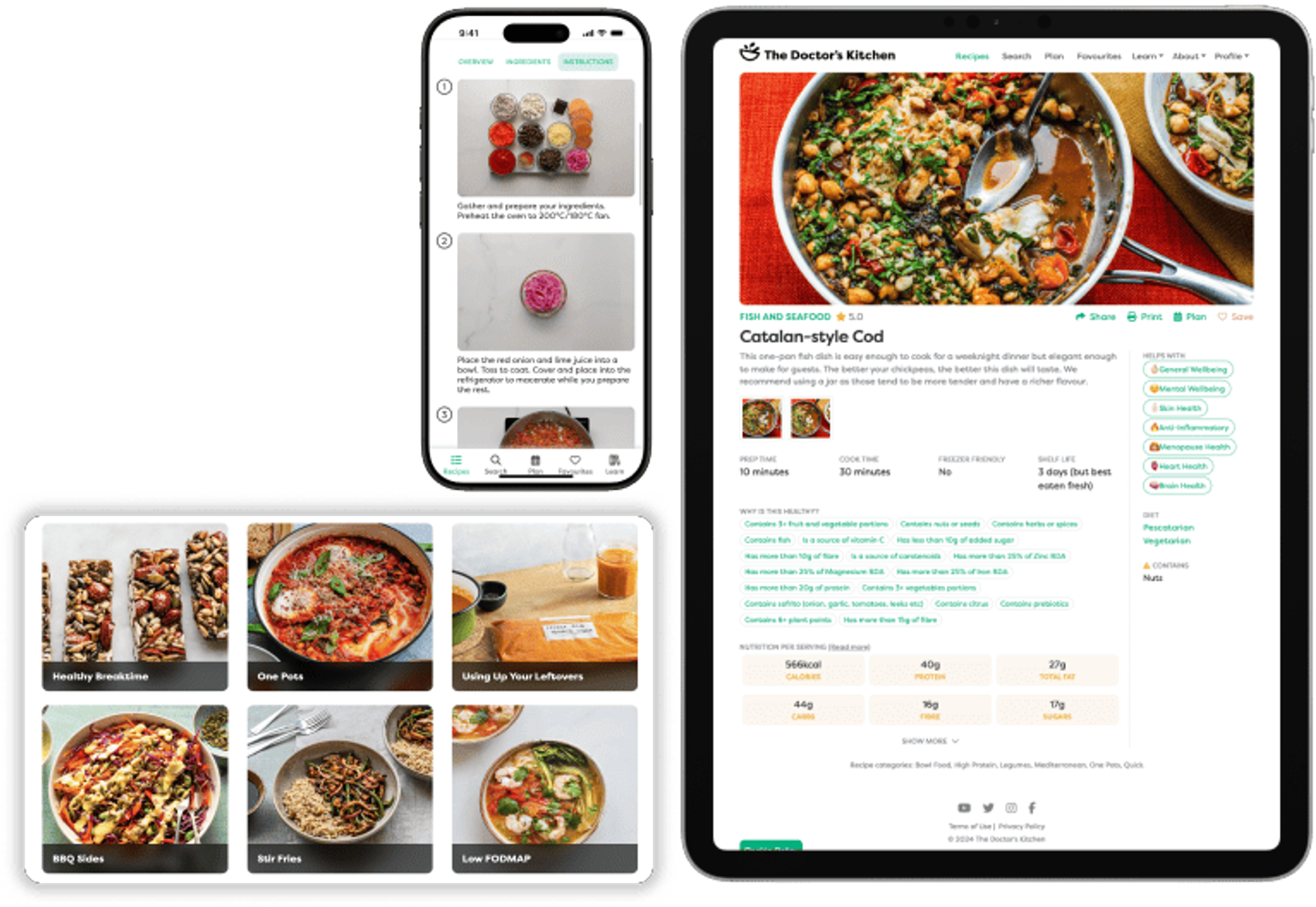
- Access over 1000 research backed recipes
- Personalise food for your unique health needs
Related content
-
Nutrition basicsWatch
3 high-protein breakfasts you can prep ahead and eat on the go
-
Cooking skillsWatch
Best high-protein foods for energy, gut health and longevity (and how I get 30g per meal)
-
Healthy ageingRead
5 habits for good health
-
Nutrition basicsWatch
Protein for energy, hormones and ageing better
-
Nutrition basicsRead
5 benefits of eating together
-
Nutrition basicsListen
#271 Why Prescribing Food Could Fix the Healthcare Crisis with Jonathan Pauling
-
Nutrition basicsRead
Eat dinner early: Benefits for sleep, gut health & blood sugar
-
Cooking skillsListen
Unprocess your diet with Melissa Hemsley
-
Nutrition basicsListen
#268 - 6 Strategies to make healthy eating easy for life with Professor Tim Spector
Podcast transcript
Dr Rupy: I'm Dr Rupy and on this show, I help you feel more in control of your health through food and lifestyle medicine. I've been talking a lot about eating more protein recently, and sometimes it feels like you have to choose a side, protein or fibre. It's confusing. Thankfully, we have clear communicators like Dominique Ludwig that are giving no-nonsense nutrition advice and simple strategies to help us all eat enough protein, because obviously it's very important, but also enough fibre and variety in our diet every week. And if we're able to eat in this way consistently, not only do we feel better day-to-day, but we eat according to our biology and symptoms of ill health, like joint pain and fatigue, can melt away. Dominique is an accredited nutritionist and registered nutritional therapy practitioner with over 30 years experience helping people feel their best. She's the author of the brilliant new cookbook, No-Nonsense Nutrition, and on today's podcast, you'll learn about the 30-30-30 method, a quick hack to build balanced plates with enough protein, fibre and nutrient-rich ingredients, as well as how to lose weight, if you need to, without counting calories. Dominique, so glad that you're here so we can have this conversation in person. What did you have for breakfast today? I want to know because I reckon it's pretty similar to what I had.
Dominique: I had Greek yogurt with some kefir, I had some milled flax seeds, I had blueberries and a drizzle of almond butter.
Dr Rupy: Amazing.
Dominique: So so typical for a nutritionist, right?
Dr Rupy: Yeah, and it's just like your Instagram as well. That's what I love because every time you make a recipe on Instagram, I just think, that's literally what I have. Like, you have your flax, you have your chia, I love shelled hemp seeds, we're going to get into all of these a little bit later on because they're just so nutritious. And one of the things I really wanted to unpack actually was like the whole calories and all that kind of stuff that we'll definitely get to. But I thought we'd start with a big question around a particular macronutrient that is getting a lot of attention, and that's protein. Why does protein matter more after the age of 30 and how much protein do you actually recommend at every meal?
Dominique: Okay, that's a big question, so we're going to have to unpack that probably slowly. Um, so all the macronutrients matter and we sometimes pull one out as being more important than the other, but really it's the combination of all of them together. But protein is really important. It's the building blocks of our body. Um, it's our important for our muscle mass, our bone mass, our enzymes, our neurotransmitters, everything is dependent on protein. So we need to be eating it every day. And one of the things I always explain to people is we don't have a store of protein. It's not like we've got a little cupboard in our armpit that where we can just get the amino acids out when we need them. We need to be eating them every day. And so that's really important. So is there a certain age where you need a bit more? Well, we didn't used to think this, but now we've changed our tune on it a little bit and we've understood the science a bit more. So what happens as we get older is that we often need more protein to have the same metabolic effect as we had in our maybe 20s and 30s. It's a bit like having um, imagine like a hearing aid and your muscles are turning down the volume. So you're not able to utilize protein quite as efficiently. So our needs, it's not that we're absorbing less, it's just that we're needing a little bit more to get that same anabolic effect, which means we're, you know, building muscle. Um, so that's one of the reasons it come it becomes really important as we get older. And also muscle mass as we age is so important. It's our balance, it's our stability, it's um, it's burning more energy for us. It's um, you know, stopping us from falling over and and which gives us anxiety and we often never get back to that fitness level again. Also it's down to our bone density. People often forget that there's protein in our bones. It's like the scaffolding that the minerals are all stuck in. So it's forming a lot of our bone density too. So really important. I think we can unpack that a bit more because there's a lot more to talk about with protein. Um, how much do we need? So this is this is quite hotly debated. Um, if I'm doing a normal nutrition program, I normally sit people around 1.4 grams of protein per kilo of body weight once they've hit sort of mid-life perimenopause, give or take. Um, if I'm with someone who's doing a lot of exercise, I might go higher. I don't generally go as high as two grams per kilo of body weight, although there's a lot of respectable nutritionists that do that. I I tend not to and the reason I don't do that is because I often find when you over prioritize one nutrient, you start to shove another one off the plate. So you start to hyper fixate about the amount of chicken and cottage cheese you're eating, but then somehow you're so full that you're not managing to eat the beans, legumes and vegetables, you're not hitting your fibre target. So I think it's a it's a balance and I think it's trying to get the get get everything in balance so that you've got what you need. But if you, yeah, go too hard on one, you're going to miss out on another.
Dr Rupy: I totally agree, yeah. You've got a real way with using analogies that I love. Like I've never heard that hearing aid analogy before and it makes so much sense that the hearing aid sort of turns down and so you've got to increase that stimulus, that input to have the same desired effect, which is in this case, the stimulus to the muscle to preserve what is an an incredible organ, particularly as we as we age. And I think when we talk about things like sarcopenia, the gradual loss of muscle mass and the quality of the muscle in terms of strength, a lot of people conjure up this image of people over the age of 60 or 70, but actually muscle is so important to build as a sort of storage facility in our earlier years, in our mid 20s, 30s and and beyond. Like how do you get people thinking about something like sarcopenia when they're in that sort of stage of life where they're they're not really sort of making the connection?
Dominique: Yeah, that's a really good question. I think the way I always vocalize it with people when I'm working in clinic or in groups is I'm not eating, I'm well I am eating for the person I am now, but I'm also eating for the person I want to be in 20 years time. And I know that when I want to age really well, I want to be able to jump on my bike and go and get a coffee from the coffee shop. I want to be able to walk. I don't want to be just watching the window and watching the world go by because I can't get out of a chair very easily. So I look after my body now for the body I want to have in 20 years time, which means I don't always make the choices. Yes, I maybe I would like to eat more cake and biscuits and things, but I'm kind of always thinking, have I had enough protein today? How am I going to preserve my muscle mass later? And again, that's, you know, strength training and things like that. And I think one thing that's really important to say is just eating protein is not necessarily just going to protect you against sarcopenia. I could I could sit and play PlayStation all day. I I don't even have a PlayStation, but and drink protein shakes. That's not going to build any muscle. You've actually got to get out there and do some exercise and do strength training to actually to to build that muscle as well. So it's a combination of both and I think it's there are no shortcuts. We're all looking for the next quick fix, the next, you know, the next diet trend, the next whatever that's going to give us that quick fix, but the quick fix isn't really there. I think you've been around the block a bit too and I think what's right in front of our nose is the food we're eating. So I think we just need to prioritize that. You mentioned a couple of numbers there, the 1.4 grams per kilo of body weight per 24 hours in terms of the total amount of protein per day, all the way up to a little bit more depending on their activity levels. So practically, and obviously this is going to be different depending on the individual, what is there like a rough number that you tend to suggest, look, this will put you in the safe zone for you and it doesn't over prioritize protein above say fibre and other nutrients.
Dr Rupy: That's a great question.
Dominique: I devise all of my recipes with what I call the triple 30 principle. So I devised this over two and a half years ago. It took me ages to actually put it into a program. Um, and what I did at that time was I thought, how do we get people to eat the right amount of nutrients over 24 hours without having to do a lot of number crunching, without putting it all into apps. And so I started to create all my recipes and the triple 30 means 30 grams of protein per meal, 30 grams of fibre a day, 30 or more different plants a week. So that means you're having 30 grams of protein, 10 grams of fibre per meal. So when I'm calculating my recipes, I'm really nerdy and I've got, I don't just rely on everybody else's data. I've now got my own Excel spreadsheet, which is which is averages of just all sorts of averages all pulled together. So I'm getting it as accurate as I can. And I'm running all my recipes through there. And so what that means is, you know, I might start by saying, oh, I know, I'm going to make this like, you know, green frittata. And I make it and I think, I've got loads of greens in there. It's bound to be, you know, full of fibre. And then you test it and you go, oh, wow, it's only three and a half grams of fibre in there. So I want another seven grams so that I'm going to hit that target and the protein's a bit low. So I might stick some cottage cheese in there, I might throw frozen peas in there. So I'm doing all of my recipes so that you with balance so that you don't have to. You can jump through any breakfast, lunch or dinner from any of my recipes knowing that you're roughly getting and it's roughly 90 grams of protein. That is an average for a 70 kilogram person. Some people need more. And so you can go up or down on that. And people are going to have extras. They're not just going to eat my recipes. People, you know, we eat, you know, lots of people are eating all the time, but um, but I think that sort of gives you a good base level. If you're if you need more, then obviously add more to your plate. And that's why I do the sort of protein and fibre top ups in my book. I kind of give you, look, this is a 10 gram protein top up. If you need a bit more protein, choose two or three of them a day, just add them to your plate. You know, it might be 80 grams of edamame beans, 100 grams of cottage cheese and 40 grams of nuts. And bam, you've done it. So I try and make things really simple so that people can hit those levels really quickly without having to rely entirely on a protein shake or something else. I try and layer it up in real food.
Dr Rupy: I'm so glad there is someone else doing the due diligence around nutritional factors because what you said there, I don't think a lot of people realize is a big sort of black box within the nutrition space and that's the quality of the data in nutrition calculators. So I'm assuming you've got like USDA data and COFID data and EU data and it's all really murky because sometimes sweet potatoes can be X amount of calories on one and then completely different on another one, but they also have different fibre and protein amounts too. So that's exactly what we do with the Doctor's Kitchen app. We have like an amalgamation of all these different databases to provide what we think is the most accurate representation of protein and fibre in our meals. And when we run it through the calculator, if it's low in fibre, we're constantly thinking about how do we annotate a recipe to make sure that you're having extras. But some of the protein boosters that you've got in your book, I just think are a wonderful sort of quick wins for for folks. You you mentioned two there, so cottage cheese and edamame. Are there any other like protein boosters that you think are a good sort of practical takeaways for folks?
Dominique: I think I I love, I've got this new thing that I'm slightly obsessed by and that's grating tofu with shredded coconut, tamari and a bit of sesame oil and then roasting it in the oven. That is, so tofu is quite good as well. So just sprinkling that over the top of your curries is utterly delicious. You've got to try it. Um, roast it until it's really crispy. Um, yeah, I mean, I think using plant proteins as well, you know, it's not about how many chicken breasts you can eat. I think sometimes we hyper fixate on the one food. So when we're thinking about protein, we're just thinking about, you know, or people are thinking of meat and fish and eggs and cheese and things like that. But we forget that actually the whole grains, if you're eating a good quality whole grain, things like freekeh, bulgur wheat, buckwheat, you've got you've got a good amount of protein in there too. If you're having your beans and lentils, you're getting, you know, you're getting an amount of protein in there too. Even vegetables have tiny amounts of protein. So it's all about layering rather than focusing on one food. That's too simplistic.
Dr Rupy: Yeah.
Dominique: But I think in answer to your question as well, when we were talking about doing those tables, I think the one thing that's that's really difficult, I don't know, this is the thing that I found the most difficult is fibre. Um, because we've had so many different ways of of measuring fibre and we've started off with Southgate and then we went on to Englyst methods and then then we've got the right, you know, USDA and AOAC and all these different all these different ways of measuring it because we're now picking up things like, you know, pectins and resistant starches and lignans and all these other things. So sometimes and also different varieties. So American varieties of foods may be slightly different to ours. You know, raspberries are a brilliant example. You know, how do we know? Do they have 6.5 grams of fibre per 100 grams or 3.5? It it's it's it's difficult to make the to do it. So I think when we're doing the nutrition information, we're just doing our best because there isn't a universal database.
Dr Rupy: Totally, yeah. And I think we're also dealing with biology as well because different people will absorb different amounts of fibre and the calories from food very differently as well, um, which is another bug bear of mine that we'll get to a little bit later when it comes to calories and foods. Um, specifically talking about protein. So we're looking at the like 20 grams of protein per meal, give or take, and you can use protein boosters depending on what your needs are. Are there specific groups of people that would benefit even more from being more cognizant of protein and perhaps higher amounts?
Dominique: Yeah, I think there's this, we have this sort of rhetoric at the moment that everybody's getting enough protein and can we all just, you know, shut up about protein and can we all please talk about fibre? And I I don't I see it as a combination. It's they're like protein and fibre to me are the dynamic duo. You can't do one without the other. You need both. Yeah, when it comes to specific groups of people, I think as we've talked about in midlife, I think children as well. I think children, adolescents, don't be too complacent about it. I I treat my children and adolescents like endurance athletes. You know, they are going through these huge growth spurts and sometimes we just we oversimplify and just say, oh, they just need energy. Um, and I think it's much more complicated. Obviously, during pregnancy, when you're breastfeeding, um, as we get older, and I think the things that can happen as you get older is it's not always planned that you eat less protein, but things like your dentition might not be quite so as good. Your partner might pass away and you're cooking for your just cooking for one. Um, there's other factors that we don't always think about in there. Um, if you're on a plant-based diet, you can get enough protein. I think it's wrong to say, oh, you have to be really careful on a plant-based diet, but you have to be more mindful. And again, if you're on a vegetarian diet, if you're just having, anyone that's just having cereal for breakfast, a meal deal at lunch and pesto pasta in the evening could well be not hitting their protein targets. Um, and so I think you need to be mindful. I see in clinic, probably like you when you've been in clinic, you've got your scales and you're measuring body mass. I do see people who are have a very low muscle mass and sometimes too much body fat even though they appear slim. And I wonder also, and I don't this isn't, I don't know what your thoughts are on this, but I we're also living in a world where we are overfed. And so when we're counting, you know, are we having enough protein, we're also basing that on on on on on possibly a lot of people eating slightly more calories than they need as well. So if we strip it back to actually what we need, I I think we just need to be mindful.
Dr Rupy: Yeah, yeah. That's a really good point actually. I think the excess or the suggestion that we're eating too much protein might actually be a factor of us eating too many calories and of the proportion of that calories, if you think of a plate, um, it still might be a small proportion actually being given to protein and a lot more given to refined carbohydrates, which is probably in line with, you know, the um, the nutrition data sets that we have at population level. And so I think that's a really interesting point that we need to a, reduce the amount that we're consuming overall, but perhaps increase the proportion from good quality protein sources, as well as making sure that we're including fibre. And that dynamic duo between protein and fibre, I think is a is a really good way of like framing it for people. It's not one or the other.
Dominique: I think the thing with protein and fibre is if you, so I always, so interestingly because I've got my nutrition tables and I'm really geeky when I do my recipes. Um, interestingly, when I work on the fibre and the protein, the calories take care of themselves. The food is bulky, so it works on all those different satiety mechanisms in the body. Um, and I think that's really interesting as well. So they really are this sort of dynamic duo where where suddenly calorie counting, which is even just using apps can be really um, um, you know, really varied. Yeah. Um, so yeah, I think if you focus on those two, everything else seems to take care of itself.
Dr Rupy: Yeah, yeah, I've definitely found that. With um, those going through the menopause, why is protein and fibre obviously, but why is protein so important for menopause?
Dominique: So I think as we get older, there's like this sort of invisible memo that goes out in invisible ink when we're about 40 and we all miss it and it's like, what worked in your 20s and 30s is not going to work quite the same anymore. It's not that we have this dial, like mother nature just turns the dial down on our metabolism and, you know, we all start gaining weight and everything starts becoming a little bit more difficult. But we've got, it's very sort of indirect. So we start to, um, we might find that our, we become more sensitive to the glucose in our diet. We're not as sensitive to the insulin. So what can happen is we start to sort of gain weight around the middle more easily and um, we have issues with losing bone density, losing muscle mass. So there's all these different things that start to happen that can have an indirect effect on our metabolism. And and what I what I see in clinic is a lot of women are trying to eat less and exercise more to try and combat that, but it's that's not working for them either. Um, so I think the protein is important because it does so much more than just, I mean, yes, I can be talked about muscles, we've talked about bones. It's also really important for our satiety and our fullness. So what protein does is when we eat protein, it's um, it's quite difficult to break down. Just chew a piece of, you know, meat and it's, you know, you've got to chew it quite a bit. And your stomach's got to carry that process on. So your stomach's a bit like this sort of washing machine and it's it's churning your food around and it's and it's throwing detergent in there, which is basically acid and uh, enzymes to try and break down that protein, but it stays in your stomach for longer, which means that it's um, it's sending messages to your brain because it's stretching the stomach. So your brain's going, hey, we've got some food, this is great. It's spending longer in the stomach, so we're getting that continued message to say, hey, you're full up. Um, but it's also sort of gets all the food, if you throw the fibre in as well, you've got like this obstacle course in the gut now. And so if you chuck some carbs in as well, it's everything's getting stuck in the obstacle course. So you're getting that energy out on a just in time basis afterwards. So you haven't got these big highs and lows. So I find personally in clinic from working mostly with women in midlife, when they are eating enough protein, it switches off the cravings. So on one of the programs I run, we have a self-reported questionnaire at the end. It's not, you know, I I I couldn't put this into um, into a big science journal. This is self-reported questionnaire they fill in at the end. 80% of people tick a box to say reduction in cravings. And I think a lot of that is due to the fibre and the protein together. Um, and that reduction in cravings stops the food noise in between meals. So it stops people wanting to snack so much because you literally just sort of forget about food. So I think it makes weight management much easier. Um, it makes people feel calmer, I want to say. I think this is if we're if we're eating foods that are disrupting our blood glucose, obviously we want it to go up and down, that's what it's designed to do. We just don't want the peaks and troughs all the time. But I think it's those drops in blood sugar where it takes our mood, our energy, our focus, everything on that roller coaster with it. So I find people just feel a little bit more stable, a little bit more in control of what they're eating. And if I get them to eat a good breakfast, I think it influences what they eat for the rest of the day. I think it stops the sofa snacking in the evening a lot because they've trust themselves to eat more. I mean, one thing if we could say, what do I, what is my, what am I trying to do with mid-life women? I'm trying to free them from these invisible food rules. What they think they should and shouldn't eat, that they should have a little tiny breakfast that's not going to fuel them and then they beat themselves up by 11 o'clock when they cave and they're and they're craving sugar because when we get hungry, I always think we turn into teenagers. It doesn't matter what you're missing. It doesn't matter if you're missing protein or whatever it is you're missing, your body just sort of mismatches that and sends out this message, go and eat carbs. And I think it's just, I think eating more protein just tends to sort of balance that out a bit.
Dr Rupy: I love that. You've got these lovely one liners like sofa snacking. I'm going to definitely use that again because it is something, I think breakfast and protein at breakfast really does anchor your day to make better decisions and reduce those cravings and you know, there is evidence around this as well. And I think also protecting your your muscle health as you age is important for that just natural burning of energy that otherwise is lost and you know, with the decline in estrogen, this is something that can be accelerated if you're not doing a exercise but be eating enough protein as well. For some people who say, look, um, I've I'm eating exactly the same and I'm still putting on weight and I'm getting the sort of tire around my my belly. How do you sort of gently explain what might be going on to them? I mean, you've already mentioned a couple of reasons already, but but this is something that we get asked about a lot.
Dominique: I think it's all about proportion. Often, it's not that we're eating the wrong food. So I get people coming into my clinic sometimes and I look at their food diary and I'm like, oh my gosh, they've got like a black belt in nutrition. They're like eating better than me. You're looking at but but then I think, no, but you're coming to see me. So there's a reason. So sometimes we're eating the right foods in the wrong proportion. And so we're just waiting that, you know, I've got very I'm very much half a plate of vegetables, quarter of a plate of protein. It's not I didn't make this up. This is, you know, but I I I've sort of, you know, refined it in the way I describe it. Quarter of a plate of carbohydrates and then you've got good quality, you know, quality and quantity with carbs. It's got healthy oils, maybe you've got some fruit, you know, we don't have to be scared of fruit. Um, and we're it's all about balance. So sometimes it's just about re just just jigging the plate around a bit. Something really simple. And also maybe becoming a little bit more sensitive to some of those fast acting carbohydrates, the ones we could get away with 20 years ago or 10 years ago, suddenly become, you know, we become less able to process that amount of carbohydrates at one meal. Um, and then the preferred storage site, like it or not is, you know, is the visceral fat. But I also think, you know, that's where it's also not an inactive tissue. It's our visceral fat is producing hormones, it's making inflammation. So we end up in this vicious circle where we become more sensitive to the carbohydrates in our food and and then then we're stuck in that cycle and it's quite difficult to get out of. So for me, I always say, look, if you've tried different things and it doesn't work, just, you know, just let's just do try my approach and see if it works. And I find a lot of people say they've tried every diet under the sun, but actually, actually sometimes it's just down to simplicity, Rupy. I find I find we over medicalize nutrition, we over complicate nutrition. I think it's such a busy world. There's so much information on nutrition, there's so many channels, there's so many people talking about it, and everybody needs something different. They need a new angle, they need clickbait, they want something to make them unique. And I think sometimes it just confuses everybody. And I think sometimes I have this thing where I say zoom out. So you and I are both very trained. I think you're, I mean, you're a doctor, I'm I've been working, you know, and you're a nutritionist now too. Um, but I've been trained obviously to go into nutrition in a great amount of detail to look at people with complex overlapping medical conditions where you're trying to find that lever that's going to have that's going to shift the dial the quickest. And but having worked in groups and doing programs, I often call it zoom out. And it surprised me at first as well. But when I I run a program called renew reset recharge. It's a sort of nutrition, lifestyle, it's a bit of a weight loss reset as well. But I watch people and I do live zoom calls, so I'm watching what's happening. But what's really interesting is that in week one, people have got lots of different conditions. And I'm not saying this is a cure for anything. This is not, you know, this is just observation. People are saying, you know, I've got acid reflux, I've got psoriasis, I've got really bad joint pain, I've got, you know, chronic pain and all these other things. By week four, all I'm doing is diet. I'm not adding in really expensive supplements. What they're doing is they're leaving sort of the standard Western diet experiment. They're sort of focusing more on real food. But we're getting astonishing results in health, things like reduction in pain and inflammation, blood pressure coming down, um, old injuries, um, improving, um, better sleep, better mood. 45% of people who tick this tick a box at the end of my of the program to say they've their mood's better. Um, and their digestion's better and all these other things, all these acid reflux disappeared. All these things start to happen. And that's not true of everyone. You can't diet isn't everything. It's it can be a really big lever or a really small lever. It depends on that person. But when I've zoomed out and I've just used food, it's amazing how many of those little things disappear. Whereas how we're trained in nutrition, if someone comes in and says, I've got acid reflux, you're all you're thinking about in that consultation is everything to to try and control the acid reflux. But actually, if we just zoom out and take a look at diet as in in general, and then you can almost go in four weeks later, see what's left over and then work on that.
Dr Rupy: Yeah, I love that. And on the subject of zooming out, I just want to underline that proportion plate because you have that wonderful image in your book of the half plate, but what why don't you just describe that again for us? The half vegetables and the the other quarters.
Dominique: So you can do this for a fridge raid lunch, meal assembly in the evening, arriving at somebody's barbecue. You just have to see your plate as a circle. And I do it what I do in the book is I call it my 1, 2, 3, 4, 5 principle. Really simple. You can remember this and just wherever you are, it's the simplest way of getting balance into your plate. Number one, where's the protein coming from? Is it um, you know, is it going to be tofu, tempeh, meat, fish, eggs, cheese, whatever that protein is. And it doesn't have to be one. It doesn't have to all be animal protein. You can mix and match all these things. It's around a quarter of your plate. That gives you the majority of your protein at the meal. Number two, vegetables. I always say 250 grams. This isn't a scientific amount. It's just what I've been using in clinic. It's about half of your plate. And it could be just that you've chopped up all the vegetables in your fridge. I try to say not tomatoes, lettuce and cucumber. I always laugh and say that's a garnish. High in water, not great in fibre. Hard vegetables, things like red cabbage, red onions, red peppers, uh, you might put some zucchini in there, carrots, and lots of hard vegetables, lots of different coloured vegetables, around 250 grams. That could be, it might be a soup, it might be a stir fry, it might be a salad. So number two is your vegetables. Number three, carbs. People that don't eat carbs often don't eat enough fibre. So while you're thinking half a plate of vegetables, I'm like nailing it with the fibre. Um, you're probably going to get between, depending on what you choose, three and eight grams of fibre from that. So you do need an extra top up. So that's where your healthy carbs come in. And that's your, you know, whole grains, how they look in nature. Your, I love freekeh at the moment, buckwheat, bulgur wheat, it might be a sweet potato, really heavy seeded breads. Um, but it's also beans and lentils, and we forget that, that beans and lentils also come in as a healthy carb there as well. And they're also really blood sugar stabilizing. So by putting your carbs in there, you're topping up the protein and you're topping up the fibre. So you've got one, two, three, protein, vegetables, carbs, or I have to keep going through because I don't want to lose everyone. Number four, oils. Oils are in your food. It might be avocado, it might be you've got some olives, it might be you're throwing some walnuts on your salad. It might be that you've got cheese, oily fish or something else already in there. But have the dressings, cook in oil. Don't avoid oil in your in your in your meals because it's it's there for a reason. It carries the flavours and, you know, we're made up of proteins and fats as well. So it's an also an important energy source. Number five, are you going to have a fruit with your meal? Maybe you chop up some apple in your goat's cheese salad, maybe you throw some pomegranate on your on your stir fry, on your tofu stir fry, or have it as a dessert at the end. And then I always say, if you want to, add three things. They're called them the bells and whistles. The bells and whistles are the things that maybe put nutrients on your plate that you wouldn't have had otherwise. So it might just be a sprinkling of feta cheese, a dollop of hummus, um, it might be you've put some extra sauerkraut on your plate. Just three extra things just to give you that nutrient diversity. I'm a big fan of putting more food on your plate rather than allowing for snacks all afternoon.
Dr Rupy: Yeah.
Dominique: I think you're much better off because often when you're making your meal, you're in the kitchen, you're around the good food that you bought from the supermarket, you're better off putting that on your plate than leaving it to chance when you're, you know, running through Waterloo station at 3 o'clock in the afternoon. That's where you're not going to make. So 1, 2, 3, 4, 5, you can do anywhere. And and it just balances. If you do that, you balance the protein, you balance the fibre, the calories take care of themselves because it's bulky and uh, yeah, it just kind of works.
Dr Rupy: I it's like you're reading my mind. It's literally this is how I think when I'm at a barbecue or I'm in a restaurant or I'm trying to mix and match something from the WH Smith because I find myself without dinner and I'm like on a train coming back to London or something like that and I'm like grabbing, okay, a piece of fruit and then there's some hummus here and then some veg here and I need to find a core protein somewhere. And that that's literally how we think about recipes in the Doctor's Kitchen and on our app as well. It's like ensuring that you're starting with that core protein, loads of veg. And there is tons of evidence around getting three portions of vegetables at every plate because I think it was the burden of disease study looking at the number of vegetables per day and you want to be aiming for around 800 grams per day, which sounds a lot, but when you start mixing and matching and you're ensuring that half your plate is that sort of harder vegetable as you put it, like you'll easily smash through that and that's associated with a whole bunch of like not only benefits in the moment like you've described on your on your program, but also long-term reduction in incidence of a bunch of cancers and cardiovascular disease and some of the biggest killers like dementia as well.
Dominique: Yeah, 800 grams sounds, I mean when I was do that on my weight loss programs as well and people go, 800 grams, like you're insane. But then you work it out and you say, look, 250 grams lunch and dinner, that's 500. Have at least 100 grams with your breakfast of either, you know, vegetables or berries or something. So you've got another, so that takes you up to 600. I make sure my math is good here. And then if you're having like, you know, an apple, some raspberries and some other things throughout the day or just, you know, carrots and hummus, something like, you know, you're suddenly you it is possible to get there.
Dr Rupy: Totally, absolutely. One thing that we we also get pushback on is when you tot some of these things up, particularly if you're using some of the extras like nuts and seeds or certain types of like seeded breads. I know you've got a beautiful seeded bread in your book as well. Um, and some of these like good quality fats, even though they are, you know, extra virgin olive oil and they're cold pressed and they're full of polyphenols and all this and a good quality protein. Oh, but the calories are 700, 800, 800. Surely this is I'm not going to be able to lose weight or surely this is too much. How do you navigate this difficult conversation with with clients and also broadly on uh, in the public sphere?
Dominique: Yeah. I get it all the time. This is too much food. This has too many calories. Um, what are the calories every time I do it. So I think it's calories is this, I mean, let's let's let's break it down. I might need a bit of guidance so I don't go completely off track. But number one, you know, how many calories do we need? It differs from day to day. There isn't this, we say, oh, you know, the average woman needs 1800 to 2,200. I know, I wear an aura ring. I know some days I'm super busy. Some days I'm burning 2,700. Some days I'm having a, you know, I'm copy editing a book and I'm basically not moving from my desk and I'm on 1700. So it varies from day to day. So just saying you need a certain amount of calories every day is is is ridiculous. And it depends on our age, our body composition, um, often our gender, how much muscle mass we've got, you know, how well we're absorbing our food. There's so many things and how active we are, active calories. Another thing when you get to mid-life, you know, we're often doing slightly less because if we're empty nesters and we've been making, you know, washing and making up four beds a week and now we're only doing, you know, two or one or whatever, it's um, you know, we're often, you know, doing less exercise as well. So exercise is super important. Um, I think when calories, it's, you know, if you just choose your food because you're looking at calories, you're not making the right decision. So if I was going to go on a, you know, I haven't been on a diet for years. I mean, if I was, you know, if you wanted to go on a diet, yes, choose cup of soup and a slice of uh, processed bread because you know, the bread's got 80 calories and the cup of soup's got, I don't know, 60 or something. You can control it like that, but it's it's completely not looking at the, it's not looking at the nutrient density. So if you're going to lose weight like that over time, you, not necessarily, but you may end up with nutrient insufficiencies. You may not have a, you know, literally a deficiency disease like, you know, scurvy where you're bruising and your teeth are falling out, but you may get, you know, you may get just be working sub-optimally, um, because we miss out on those micronutrients and they're like biological keys that unlock all the chemical reactions in your body. I call them like stardust. They're like stardust that make everything work in your body and make you feel well. Um, so you want your stardust. So if you're looking at calories, you you're often looking, you're often looking in the wrong place. So when it comes to, yeah, nuts and seeds, nut breads, things like this, what we're forgetting in that is that calories are satiety. And if you're having a handful of nuts, a, unless you're going to sit and chew it a hundred times, you're probably not going to get all the calories out. I think Zoe did um, or Sarah Berry did something on this where she said, a handful of nuts is, if whenever I put it in my hand, it's about 25 to 28 grams. It may be about 150, 160 calories if I chew it meticulously. Most people don't. So you may only get, you know, 70 to, you know, 70 to 150 depending on how well you're going to absorb it. So we get really nervous. 150 calories is not a lot of food. So we have to look at how foods fill us up. And the easiest way to look at this is to look at something like, let's compare an avocado to a chocolate bar. So I may, you know, I can I can lose weight on a Mars bar diet if I wanted to, right? Everyone could do that. I mean, I'm not going to do it, but if I ate less calories than my body needed, so calories matter in that they are a they do help us in that way. I could lose weight, but I would probably would feel flipping awful doing it. Um, I can give myself a blood sugar spike in 10 minutes on milk chocolate. I've tested it and but what happens when you're having um, you know, foods that are calorie counted, they're often more processed, um, so you're going to get almost all of the calories out of that food. So the more processed the food is, the more you're going to absorb. So you're getting like, you know, 90 to 100% of the energy out. Let's compare that to half an avocado and maybe you've put um, I don't know, some crispy tofu in it or something, you know, something you and I do. Maybe someone else would put prawns in there. But you know, if you're having that avocado, what you're actually eating is a mixture of fibre, you've got folate in there, you've got healthy fats, you've got B6, you've got all sorts of nutrients in there as well. So it's delivering nutritionally, but you're not going to absorb all of that. Your gut microbes are going to have a feast on that on that fibre. It's going to be take longer to go through the gut. It's going to also start to push satiety hormones in the body. So it's going to give you a much smoother energy, um, glucose, um, blood glucose levels over time, whereas you're not going to get that big boost. So if you just go for that maybe meal deal that, you know, at lunch that you just it's poof, you've absorbed it. It's going to make you really hungry later on. So I think calorie counting can make you hungry and can actually backfire. And I think is this a really good time to talk about things like satiety and how that works? Because I think that's really important. I think for me, there's different, you know, there's if you're eating, the more processed your diet, the quicker and the quicker we digest it, the less able it is to turn on natural satiety mechanisms, which means we're more likely to feel hungry sooner, which means we're more likely to eat more calories than we need over the day. Whereas if we're eating things like the seeded bread, nuts and seeds, we're having some hummus, we're having some olive oil on our salad, um, what we're doing is we're, first of all, we're eating bulky food, so it's stretching our stomach. That sends a signal immediately to your brain to say you're full. And then you go into the small intestine, and I describe the small intestine, it's got like cells which are like mini laboratories. They're testing your food in real time. And they are going, yes, there's protein here, there's carbohydrates, there's fats. They're sending a message to your brain to go, yep, you've eaten some food, you're still full. The bit that's really important, I think, is that long-lasting satiety. And that's the bit where we start, we talk about GLP-1, you know, and PYY, these other hormones. They sit a little bit deeper often in the gut, sort of in the, I mean, they are throughout the gut, but they're more concentrated at the lower end of the small intestine and the colon. And so you need a sort of residue of food. So if I've just eaten something that's I've just been so easy to digest, I've absorbed it instantly, it's not going to hit those cells which are producing those long-term satiety hormones. And so that's what really keeps us going from sort of hours two to four in between meals. And it's not that snacking is inherently bad for us. But when we start to eat that way, we forget about food. So having that seeded bread with the avocado and a drizzle of olive oil and maybe some walnuts on your salad, what you're doing is you're creating this whole, you're working with your biology and so that you're naturally, you don't feel deprived. I mean, I'd feel hugely deprived if someone gave me a cup of soup and a slice of bread. I mean, I would literally be beside myself. Um, whereas and you and what happens is you naturally stop feeling hungry. So you suddenly find yourself not being able to eat that last bit of food on your plate and you go, I'm done. And that's a really nice, that's that's really empowering particularly for women.
Dr Rupy: I love that. I don't think I've ever heard anyone describe that that lasting satiety effect of food in the way that you've done, which makes so much sense because if the listener just imagines how long our digestive tract is, you know, it's around 12 feet or something. I always get the feet or meters mixed up, but it's it's long. And you have the winding small intestine, which just goes on and on and on. And then you have the distal portion right at the end, which is the large intestine. But what you're and the image I've got in my mind now from what you've just described is bang on. You got a meal deal, which is full of mushy food, which is, you know, delicious and it's got that lovely salt and sugar balance and you feel good at the moment when you're eating it. But that is not going to have that residual effect later on at the latter part of your small intestine, which also signals to your brain, oh yeah, we're full down here as well. You're just going to get the initial one.
Dominique: It's the fibre.
Dr Rupy: Which is, yeah, which is fibre, which is why you don't get that lasting satiating effect, which is why you find yourself snacking. I vividly remember when I was at med school, I would eat so much processed food in a sitting and for some reason, I never figured it out. Three hours later, I could still go for an ice cream. I was like, yeah, I could still I could definitely do that. And that's why, because I wasn't truly filled and I didn't have that lovely mix of nutrients that were still signaling to my brain that I'm full.
Dominique: Yeah, when I mean I studied nutrition in 1991 to 1992 at King's, we didn't even learn about the microbiome. We called fibre roughage. It was like it was like half a lecture. We did not wasn't until I studied nutritional therapy and went on and did that that we're actually going, oh, the microbiome, this is this is fun. It was we didn't even talk about it.
Dr Rupy: That's wild. It's wild.
Dominique: When I'm doing my even a weight loss program, I don't talk calories. I tell people, don't track your calories, don't count your calories, and I don't put calories directly on the recipes because I want to free women up. I think most of my clients are women, but I get some, I've got men doing the program with me this month too. I think when I I said earlier, I mentioned invisible rules around women. I think women have hang ups pushed on them from from a very young age about food, what they should and shouldn't be eating, the guilt around food, and I'm trying to free people up from that. And I think when you start to eat the balanced plate, you start to become in tune with your own hunger and satiety cues. It's really freeing. And you know, I counted calories in my 20s. I I don't even know why. I mean, I would like say, oh no, no oil on my salad, please. And you know, that rubbish, drinking diet Coke because it's free. Um, you know, I did all those things as well, but I never felt, I I always felt I had to overthink food. Whereas I think if you eat well, don't worry about the calories, your appetite will take over.
Dr Rupy: Yeah, yeah. I think it's so important and uh, it's why actually on the Doctor's Kitchen app, we have a function where you can remove all nutrition data because it can definitely be triggering for a lot of people and I think we over index on on on calories. Um, evidenced by so many people asking about calories in our in our recipes. And I understand it if you're an athlete or if you're a bodybuilder, if you're trying to literally get every sort of ounce of fat off your body, but for the majority of people that just it doesn't compute, it's not necessary.
Dominique: Because it's not because it's different every day.
Dr Rupy: I have a I have a reveal calories button on my website where you can if you want to know, you can push it. If you don't want to know, you don't know.
Dominique: Yeah, that's that's perfect. Um, you have this wonderful analogy that I saw on Instagram recently of penguins and giraffes. I wonder if you could talk us through that because I think that's really empowering for a lot of people to ensure that they don't set unrealistic expectations for themselves. And I think a lot of people do.
Dr Rupy: Yeah.
Dominique: So, I didn't actually do well that post. I thought it was I thought it was brilliant. I think my algorithm just thought, I've never seen anything like this before. I have no idea what she's doing. Um, so often when I'm in clinic and I'm working with people, I find that people have an unrealistic expectation of what they want to be. So they say, do we have a set point? And we all kind of have a set point. And I often laugh and I say, we do and it's not always the Elle Macpherson set point we would have chosen for ourselves. So, okay, so we've got genetics playing a role here. We are given a certain shape. We come in different shapes and sizes. Some of us are broad, some of us are are taller. And so I kind of linked it to like a penguin and a giraffe. And I said, if you're born a penguin, be the most incredible penguin you can be. Be healthy, you know, be happy, be kind, be a lovely penguin. But if you're always dreaming of being a giraffe and you're always trying to be um, you know, taller, slimmer, more lithe than than nature has allowed you to be, you're never going to be satisfied with who you are. So just be a if you feel like you're a um, a giraffe disguised as a penguin, just be that, just own the penguin and be where meet yourself where you are. Because so many people are trying to be something they're not.
Dr Rupy: Yeah, absolutely. And I think it really just speak to me because I think, I mean, especially when I was a lot younger, I really wanted a particular body type and you know, you you spend a lot of your time reading men's magazines and wishing that you look a certain way or you had a certain build and all that kind of stuff. And I think, you know, not to generalize, but it does feel like it is worse for women in terms of setting unrealistic expectations on themselves. And I think, you know, it's testament to the algorithms and magazines and all these sort of like unrealistic images that we're bombarded with. But when we can be happy as a penguin or happy in whatever, you know, animal analogy you want to use and being the healthiest, happiest version of that, I just think it just frees you.
Dominique: Be happy feet, yeah.
Dr Rupy: Be happy feet. Yeah, exactly. But I think also we focus on the weight as well. And the weight is just, you know, it's a it's an effect of gravity on something you're standing on. It doesn't it's not a reflection of how how kind you are, how funny you are, how intelligent you are. It's just, you know, it's just the effect of gravity on a on a on a piece of metal that you're standing on. So, you know, we over fixate on the scales, you know, and then and you know, I think that's that's wrong as well. You know, we should be focusing on, you know, how much muscle mass we've got and things and if you have more muscle mass, you're going to weigh more. I've gained half a stone this year because I've started strength training. I can now do seven pull-ups unassisted.
Dominique: Seven pull-ups. Wow.
Dr Rupy: So I've gained more muscle, but I'm not worried about it. You know, I think it's
Dominique: That's amazing.
Dr Rupy: No, no, no. My wife's going to be very jealous. I'm going to make sure I mention that to her today. Um, okay, so we've talked about our beautiful proportion plate. We talked about how much we should be aiming for in terms of protein, some of these like high protein anchors you mentioned, uh, Greek yogurt for for your breakfast and and cottage cheese and some other things. In terms of like quick protein top ups that you've got in your book as we've got a lovely uh, image. What what are things that come to mind? You're like, oh, I need an extra five grams or 10 grams here. Like what what are some of those like quick things that people should have?
Dominique: I might add things like hemp seeds to my breakfast, chia seeds, um, flax seeds. So just adding a few nuts and seeds to your plate's going to top up. It's all about layering. It's not about going crazy on one extra food. Sometimes just having some Greek yogurt and raspberries for dessert, you know, just having that at the end of your meal, making a, um, putting tahini on your breakfast. It's just it's all little tiny gains. I mean, one of my favorites is probably like beans, lentils, edamame beans because they top up the protein and the fibre at the same time. Edamame beans are just really good because there's like 80 grams of edamame beans, you've just topped up five grams of fibre and 10 grams of protein and they taste great and most kids like them and um, yeah, so I think just a mixture of different foods.
Dr Rupy: Yeah, yeah. If we were talking through like a couple of meals here that we can upgrade, right? I want to make this super practical for for people. Um, breakfast, and you know, you mentioned why you're such a fan of of breakfast. Actually, why do you place such an emphasis on breakfast protein? I know you talked about anchoring your whole day, but are there any other things that you've particularly noticed if you just change one thing around breakfast?
Dominique: Yeah, I used to push breakfast till quite late until I started to wear a blood sugar monitor. And I was like, whoa, what is going on here? Um, so I think particularly for women, if you're having breakfast in the morning, it's you're replacing the pro protein and fibre in the morning is just going to make you feel more stable on an even keel. We can feel great on stress hormones. So if we've got stress hormones running because we're not eating any food, because the body has to start putting glucose into our system in some shape or form. So some people produce more stress hormones than others, but that can make you feel quite unsettled as well. But it also can give you make you feel energized. So you think you're winning, um, but you're not nourished. So for me, nourishment early on in the day. And I think there is research to show this. It's about it's not about having to do long intermittent fasts for women. I mean, you can still do 12 to 14 hours overnight, but it looks like the research is saying, actually, look, it's better to eat earlier in the day. You're better off eating at 9 o'clock, 2 o'clock, 6 or 7 o'clock than you are pushing through to lunchtime just because breakfast is an easy meal to miss and then eating at, you know, 1 o'clock, 5 o'clock, 9 o'clock. Metabolically, it's not as beneficial for you from a point of view of your cholesterol, your triglycerides, your blood sugar control. So I think eating earlier in the day and you also are awake for earlier in the day. When we're talking about women's health, I find a lot of women who sit with me in clinic put a lot of emphasis on that evening meal, the family meal that they're all having together. That's normally really good, but they don't always prioritize themselves as well. So they'll just grab something for lunch, they'll have a latte instead of breakfast. They're not really focusing on what they're eating, but we're awake all of the day. We're sleeping all night. I don't need loads of energy while I'm dreaming in bed, but I do need it when I'm holding, you know, Zoom conference calls and I'm writing articles and I'm I'm doing all I need the energy in the daytime. So sometimes we think the evening meal is the biggest one. I don't make any differentiation between between lunch and dinner from a calorie perspective or how I set the plate out. Um, but also, I think that just getting that breakfast in, it changes what you eat for the whole day and it can give you more energy, make you a calmer, happier person because you're you haven't jumped straight on that sort of blood sugar roller coaster.
Dr Rupy: Yeah. If you could recommend some recipes for breakfast that people should know, um, so they can always sort of refer back to it as it is so important and as you you were mentioning, you know, you are a lot more metabolically active earlier in the day and there is evidence to suggest that we should be eating slightly earlier rather than pushing it later into the to the evening. Um, what are some of those sort of breakfasts that everyone should know?
Dominique: I think there's I think it needs to be quick, it needs to be simple. I have a lot of what I call jam jar breakfasts, things that are really quick. So the one we've talked about earlier, we know Greek yogurt, put some kefir in it, put some linseeds, flax seeds or whatever. That that's sort of a that's quite standard. And you can get 30 grams of protein, 10 grams of fibre really easily in that. If you're having eggs, two eggs, as you know, 12 grams of protein, you're a bit of a shortfall. What I tend to do is I cook my scrambled egg and then I add like 100 grams of Greek yogurt just at the end, takes it off the heat, makes it go creamy, doesn't necessarily, you know, change the texture, but doubles the protein. So I do that and make sure I've got vegetables as well, maybe a piece of my seeded bread. I'm a big fan of, I love sardines. So often if I'm coming up to London for the day and I know I just don't want to be in that situation where I'm stuck at WH Smith's looking at the food. I don't want to be there. That brings me out in a slightly cold sweat. Um, so I might have a piece of bread, I might put some avocado on it, a bit of cream cheese, a tin of sardines, sometimes a poached egg on top. Tomatoes, that's something I think just it it just makes me a happier person and it takes the stress out.
Dr Rupy: Totally. Yeah.
Dominique: Um, so there's lots of, I think just
Dr Rupy: These are literally my breakfast. I I I I have sardines all the time.
Dominique: And stop thinking sweet or savory. Is it sweet or savory? I get this all the time. Oh, that's you've put fruit on that on that breakfast. Now you've made it sweet. And I'm going, that's a sweet breakfast is I'm going to go and have, you know, Frosties, granola or a pan au raisin or something. Um, not to say that, you know, there are, I anyone that knows me knows I have a slight loving of pan au raisin, but um, I'm not going to have it for breakfast every day. But having fruit on your breakfast paired with your Greek yogurt and your nuts and seeds is not a sweet breakfast. It's a somewhere in between breakfast. And we now know there was some great research this year saying people that eat two pieces of fruit a day as part of a balanced diet, so it's, you know, is going to reduce your chances of, I think it was cardiovascular disease, different cancers and all cause mortality, which I, I mean, we're all going to die of something, but we might just be able to kick the can down the road a bit longer. Um, so I think we've got really frightened of fruit and we forget just how, you know, brilliant it is for polyphenols and you know.
Dr Rupy: Absolutely. Absolutely. I'm in my porridge era right now where I'm having uh, not just oats on their own, but like porridge oats, milled flax seed, sometimes milled chia, and then like almonds that are either ground or flaked just so they're easier to stir through, raisins, coconut that's shredded, and then if I do need a bit of a protein top up, then I might have like an unflavored protein powder just to mix through there. But I'm going to try your hack of adding Greek yogurt actually because that makes a lot of sense. You can get like 10 grams if I just add like 100 grams of good quality Greek yogurt and just stir that through with a bit of, I usually use water because the flax and the oats are releasing those viscous fibres and it's making it creamy.
Dominique: Kefir. Kefir is another one. Yeah, yeah.
Dr Rupy: Yeah, I think and the oat, I'm I'm really into oat bran. So oat bran has got like 50% more fibre, 50% more protein, cooks in a flash. And I'm like you as well, mix it all up with all the other seeds as well. It's not I think oat gets a really bad wrap and the thing and it's and you don't sit down and eat like a whole bowl of rice on its own or a whole or a whole baked potato. So why do we suddenly think we should be eating a whole bowl of oats? It's all about it's all about the clever pairing of things.
Dominique: It's a mixed meal. Yeah, yeah, yeah. And I use frozen berries quite a bit or frozen fruit in general and I just throw those in and that that adds some natural sweetness as well and maybe a top of a bit of honey. Uh, but yeah, no, I'm really in my my porridge era at the moment. I love it. But it's not like your average porridge like you, you know, saying, it's not just like oats on their own. It's really about that complexity and adding that structure to a meal that is going to end up in the washing machine in your stomach and actually as a as a part of that, you know, you're going to have uh, longer lasting energy and and less blood sugar.
Dr Rupy: And you can do without protein. I mean, you can add protein powders in if you need to, but you can actually reach those levels without, which is really interesting as well.
Dominique: Exactly, yeah. Do you have any, what what actually, what are your thoughts on protein powders? Like do you
Dr Rupy: Yeah, so I think it depends on the type. So if you're going to class them under ultra processed foods, and this is what happens, they, you know, they have to fall under what's called Nova class four, which they have to be classed as an ultra processed food because you've extracted the protein from its original form. But the Nova classification doesn't also look at nutritional quality. So if you've got a protein powder that's full of fillers and sweeteners and stabilizers and things, it's in the same category as like a a really pure whey protein powder as well. So I think for me, they're they can be convenient, um, they taste really nice, they can be really useful if people have got poor appetite or you need to boost up their protein for any reason. So I think they're a useful addition on top of food. I think if you're having like two a day so you can eat badly, that's obviously not the not the right way of looking at it. But lots of the ones have been um, you know, a third party tested to make sure that they're that they're they're really good. You can get a plant-based one or you can get the whey ones. So yeah, I think they can be really helpful as well. I just think it depends what you're buying. It's the same with most foods. There's a sliding scale on ultra processed foods. You know, we all know that a cheesy whatsit is not going to be quite as good as a kettle chip. You know, but it's not saying that kettle chips are fantastic, but there's a there's a sliding scale and it doesn't, you know, we don't all need to Yeah, yeah. And I think what the food industry is is adding protein powder to the cheesy whatsit to give you the health halo that it's better for you, but we all know, especially those listening to this pod, um, that that's not the case. Um, let's talk about salad. So I think a lot of people automatically think I'm having a salad, that's healthy. I'm getting enough fibre, right? How would you upgrade a salad to make sure that it's hitting all those things that we talked about?
Dominique: Yeah, not necessarily hitting your fibre targets and it's not hitting your protein targets. It's not it's it's a good base. It's the obstacle course. So I always think of that like your obstacle course. You've got your making just making digestion just that little bit harder. Um, depends what you're choosing from a vegetable perspective. The ones that have got the highest fibre are the ones that you know as you're eating them, things like, you know, kale, Brussels sprouts. You can grate Brussels sprouts into a salad. Um, I put red cabbage in my salad. So it's using hard vegetables, I think, rather than all the watery ones, you're going to get a bigger bang for your buck. But then you it's the same 1, 2, 3, 4, 5 principle. Are you going to add a good protein source? What what's that going to be? Well you're going to add some protein to it. You're going to add some whole grains. Maybe you add some, I I do this thing where I do a jar and I've got it in my book. Um, it does sort of come out a little bit of a mess because they're all muddled up together. But I take five different whole grains. So I take black lentils, green lentils, maybe some buckwheat, some um, freekeh and I don't know, bulgur wheat or all sorts of things. Um, so I try and use, so I mix all five up together. They all roughly cook in about 25 minutes. So I put them in a jar. You nice layers at the beginning, looks beautiful. Then you just shake it up and then you cook them and keep them in a jam jar in the fridge. Just run some of them through your salad. That way you've got the lentils, which is slowing down the um, effect of the whole grains. Um, but you need whole grains to get the energy out of your food as well. It's not, you know, we've gone so anti-carb. It's all quality, quality and quantity. Eat the right amount of carbs for your body, but the right quality of carbs as well. Um, adding nuts and seeds. I think it's just it's all layering. We've just got to layer our food. We think we just sometimes see it as individual units on our plate. It's just layering all those foods up and then your appetite should start to just take over.
Dr Rupy: Yeah, yeah. It's almost like seeing your plate as 3D rather than the 2D sort of dimension that we're used to seeing. Like it is about getting the layers, not only from a nutrition point of view, but from a flavour point of view. So whenever I think about food, like we we're going to have some lunch a little bit later, but part of the the freezer meals that we've just done, we've introduced loads of different flavours at different stages. So when I'm caramelizing my onions, that's providing the sweetness. And then when I'm adding the greens, that's adding bitterness. And then when I'm adding the coconut milk, that's adding fats. And then I'm also adding like chickpeas and and like chicken as the the fibre and the and the and the protein. And it's not just, you know, just little things and different places of your plate. It's it's throughout the whole uh, um, process of cooking. So
Dominique: And a good dressing. I think, you know, I think you can make anyone eat a good salad if you make a good dressing. I think that's really important. Even children will eat salad if you can make an amazing, you know, peanut spicy dressing or something. So I think, um, I think what when I've in in the way I wrote the book is all about the it's all about the plate. And so all of the, my mom saw the photos. She's like 84. She's like, Dominique, she said, I've seen some of the photographs. She goes, they're very pretty, but could you not put a few napkins and things out for me? And it's a very different sort of cooking book because it's all about the plate. So what I've done is I've plated it all up to get to show you how to get 30 grams of protein, 10 grams of fibre. And so everything you need is on the plate already. So there's the salads, there's the dressings there. So it makes it easy for people just to do it. But but we didn't want any props on there as well. So it was just it's just about the food.
Dr Rupy: I love that. I love that. That's awesome. Okay, so that's how we upgrade a salad. What about pasta? A lot of people, like pasta is almost like uh, the enemy. It's like, oh gosh, I can't have pasta if I'm trying to lose weight. How would you like completely revamp a pasta to to be fitting to to these sort of principles?
Dominique: It's a great example of this. So let's talk things like pesto pasta. So pesto pasta really simple, been a hard day at work, you know, you've got a bit of you've got a jar of pesto, you've got some pasta, but you haven't created a balanced meal there. It's way too, I mean, you know, way too heavy in carbohydrates, not enough protein, not enough fibre. So again, use the 1, 2, 3, 4, 5 method. Think, where's my protein? Maybe take a chicken breast. Okay, great. I've got a chicken breast. I'm going to chop that up. I'm going to cook that with half a plate of vegetables. Okay, so I've got some peppers, some broccoli, um, you know, green beans, anything you've got. Maybe just find, so you start to cook the the chicken with the vegetables, add some green pesto, better if you can make it yourself. It's so quick and easy. Um, maybe you stir through some Greek yogurt. Now you've got a slightly creamy sauce. Now you haven't got room for a massive great plate of pasta. So the pasta becomes the accompaniment. It's not the star of the show. So what you've done just by changing what you're doing, you've now created a meal that's going to work with your biology. And that doesn't have to be chicken. That could be, it could be, I I love just, you know, cooking frying tofu till it goes crispy. You can, you know, there's lots of other things you can use. You can even throw beans into your pasta sauce. But just changing the emphasis. I always say the filling's more important than the sandwich, the topping's more important than the pasta. And I think when you're thinking like that, you can start to recreate a meal that's going to work with your biology and then you're not going to want to be sofa snacking all evening because you're because you've got the balance wrong. Just getting proportion right. It's all about proportion.
Dr Rupy: Yeah, absolutely. I've got into this habit of getting, you know those uh, tempeh blocks, they're like quite rectangular. I kind of slice them very thinly and then I pan fry them on each side so they go crispy. And then I chop them up into almost like, you know, remember those bacon bits that you used to get from pizza hut? Like that with a little bit of like, you know, seasoning and salt and that and then I sprinkle that onto salads or pastas just as like a little garnish and it's adding that extra protein and fibre even for folks that don't like the idea of tempeh or tofu. It's a nice little boost to your meal.
Dominique: Yeah, you can do so much with it. And I think it's always always cook more than you need. And I don't mean that in a wasteful sense. I mean, you've got, you know, if you're making that whole, you're probably not going to eat the whole block of tempeh. It's going to be great the next day when you can just, you know, quickly stick it in a frying pan or in the air fryer, crisp it all up again. And then you've got it. If the if you've got the food in your fridge, you're so much more likely to use it. So always cook more grains than you need, cook up your more lentils than you need. And it's so easy just to run them through a salad if you've got them.
Dr Rupy: Yeah, absolutely. Our our fridge is full of those uh, glass tupperwares of like leftovers and stuff and like, you know, you just make like picky bits and random meals together. And if you've got your principles, you know, this 1, 2, 3, 4, 5 method, which is stuck in my brain now, um, it's going to be easier for you to make better decisions that like you say, work with your biology. Um, Dominique, this has been great. Thank you so much. This is wonderful. I I just love how aligned we are in the way we communicate and the way we think about protein and fibre as this dynamic duo and you're just such a brilliant public communicator and it's wonderful to see someone like yourself with so much experience, you know, have some success with the books and your programs and stuff. It's it's wonderful. It's really, really great to see.
Dominique: Thank you. Thank you for having me.