Professor shares 8 foods to lower inflammation and help you age slower | Professor Robert Thomas
23rd Sep 2026
If you want to stay healthier for longer, one of the best things you can do is lower chronic inflammation. The great thing is, food is one of the most powerful tools we have.
So I sat down with Professor Rob Thomas, consultant oncologist at Addenbrooke's and UCLH, Professor of Sports and Nutritional Science, and one of the UK's leading experts in healthy ageing, to talk about what makes the biggest difference.
We cover:
- The best foods to lower chronic inflammation
- The link between inflammation and ageing
- How to reduce your biological age
- Why grip strength predicts how well you'll age
There are so many practical takeaways in this one. I hope it inspires you to add a few more anti-inflammatory foods to your plate this week!
Episode guests
Professor Robert Thomas is a NHS Consultant Oncologist at Addenbrooke's and Bedford and Hospitals. He is also a Clinical Teacher at Cambridge University, the health journalist for National World News, a colomist for the DailyMail, a Professor of Sports and Nutritional science at the University of Bedfordshire and author of the bestselling book "How to Live"
He was recently appointed Head of Integrative Oncology at The Royal London Hospital for Integrative Medicine, where he advices self care, lifestyle, complementary and nutritional strategies which aim to help well being and improve outcomes.
At Cambridge and Bedford, he manages patients with chemotherapy, hormonal, radiotherapy and biological treatments. He also leads a Lifestyle and Cancer Research Unit which designs university approved scientific national studies that evaluate the impact of exercise, diet, gut health and natural therapies on cancer, long covid, other chronic diseases and exercise performance. He is currently chief investigator of the national covid vaccine nutritional intervention study and the UK YourPhyto study which was the World's first clinical evaluation to show that an intervention to improve gut health (Yourgutplus) combined with a phytochemical rich supplement (Yourphyto) slowed prostate cancer progression, improved urinary symptoms, reduced markers of inflammation and improved overall strength. His over 100 peer viewed scientific papers and presentations published from this research, can be accessed on cancernet.co.uk/rthomas.htm.
For this work, he has been awarded the Royal College of Radiologist and Oncologist research medal, an honorary Fellowship at the British Society of Lifestyle Medicine, and "Oncologist of the Year" by The British Oncology Association.
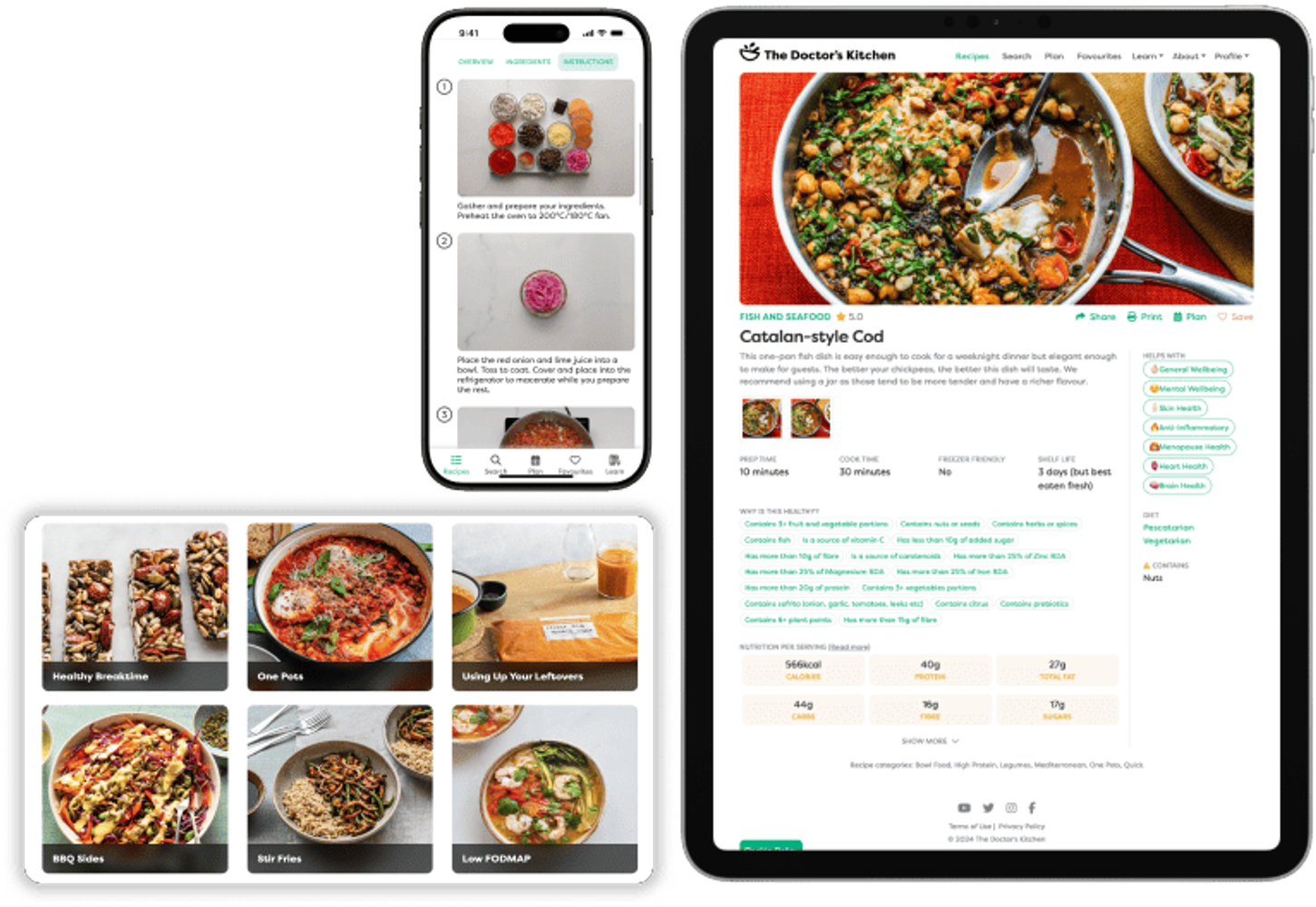
- Access over 1000 research backed recipes
- Personalise food for your unique health needs
Related content
-
Immunity & inflammationWatch
My 10 anti-inflammatory habits to feel my best and age well
-
Healthy ageingWatch
The 11 longevity foods I eat every week to lower inflammation and stay healthy for longer
-
Bone healthWatch
My high-protein smoothies made with anti-inflammatory whole foods (gut-friendly, no additives)
-
Cooking skillsWatch
My freezer meal prep for healthy dinners on busy weeks
-
Immunity & inflammationRead
My 5 steps to eating healthier in 2026
-
Healthy ageingWatch
My 5 simple steps to eat healthier in 2026 (more energy, better focus, lower inflammation)
-
Healthy ageingListen
#317 How to Support Muscle Health for Longevity and Improving Metabolism | Dr. Gabrielle Lyon
-
Hot topicsRead
How to stop eating too much sugar
-
Healthy ageingListen
#312 Professor Shares 6 Longevity Nutrients to Preserve Your Strength and Help You Age Better | Professor Ailsa Welch
Podcast transcript
Dr Rupy: I'm Dr Rupy and on this show, I help you feel more in control of your health through food and lifestyle medicine. One of the most important ways we can impact our health, feel stronger and more energetic every day and even slow ageing is by lowering inflammation. And the good news is that what you choose to put on your plate is a powerful lever to reduce it, alongside improving sleep, moving more and stressing less. So today, I'm joined by Professor Robert Thomas, NHS consultant oncologist at Addenbrooke's and Bedford Hospitals and head of integrative oncology at the Royal London Hospital for Integrated Medicine, where he advises lifestyle, complementary and nutritional strategies to improve patient outcomes. We're going to discuss the eight key foods he believes we should be eating every day to optimise inflammation to help us live longer, healthier lives and protect us from diseases of ageing including cancer and heart disease.
Dr Rupy: Professor Rob Thomas, if I reduce inflammation through food, can it help me age slower and live longer?
Professor Rob Thomas: Well, the simple answer is yes. There's lots of data to show that people who are living with chronic inflammation are, have a shorter biological age. And there's various markers of longevity or ageing and there's a direct correlation between higher inflammation and more likely to get ageing related diseases such as arthritis, dementia, heart disease, diabetes, raised cholesterol, I mean the list goes on and on and on. But they're more likely to get other biomarkers of longevity, so reduced grip strength, lower testosterone or hormone imbalance and higher markers of inflammation. And we can go on about how you measure inflammation, but yes, that's a long way of saying inflammation increases ageing.
Dr Rupy: Okay, so some of those markers of longevity I want to double click on. One of them being grip strength, we've got this cool looking gadget here, but mobility, arthritis, independence, all these things. Are these the sort of macro features of longevity that you're interested in? Because there's a lot of attention being given to other sort of novel biomarkers like ageing clocks and and so forth.
Professor Rob Thomas: Um, yeah, we we're going to come on to the study which we've recently published and you know, what we wanted to look at is what are the practical measures of longevity. So, you know, we can look in the mirror and if we see, you know, grey hair and lots of wrinkles and things like that, but it's very hard to quantify that. Grip strength is is actually one of the most reliable biomarkers of of ageing. We know that if you have poor grip strength related to your age, you're more likely to die earlier and get a chronic degenerative disease such as arthritis and all the ones I've just mentioned. And it's and it's great because it's an easy tool. I mean, the grip strength monitor costs, you know, less than 50 pound. Patients actually quite enjoy doing it and it takes a few seconds and it's there's there's hundreds of trials which have validated the results against other diseases. So it's a great one for a trial. We can do the usual markers of of, you know, ageing such as C-reactive protein, lymphocyte and neutrophil ratios, which is just a blood test as well. You can measure things like haemoglobin A1c, which is a marker of of diabetes or and things like cholesterol as well. But I like I like grip strength because it's a it reflects your overall exercise ability. I like simple tests like neutrophil to lymphocyte count, which is a simple marker of inflammation. And a measure in men of of testosterone. Now, men's testosterone normally declines. It's not like women where it just sort of falls off a cliff in the menopause, but it so there's no such thing really as a manopause or but, uh, but you know, it does decline with age. And when you have lower testosterone than it should be for your age, you're more likely to get lower grip strength, worse gut health and more likely to get a degenerative disease.
Dr Rupy: Oh, so it has an impact on gut health as well? Testosterone?
Professor Rob Thomas: Well, the other way around really. If you have poor gut health, you're more likely to have lower testosterone.
Dr Rupy: Okay.
Professor Rob Thomas: So, yeah, so I think, you know, there are more complex measures such as you can measure telomere lengths and all sorts of genetic markers. But they're they're more expensive and harder to do and I don't really think they're that relevant when we've got simple tests which we can, you know, introduce into clinic or measure yourself every day.
Dr Rupy: Okay. So you've convinced me, I need to reduce inflammation. It's going to have a knock on effect on all these things, particularly practical markers of ageing like grip strength because I imagine if I've got better grip strength, I'm more mobile, more likely to catch myself and hold myself, you know, do my daily activities. When it comes to inflammation itself, how do you actually explain that to your patients in clinic?
Professor Rob Thomas: No, that's a good point because of course we need inflammation. If we get stung by a wasp or if we have a cut, you know, we we need to the inflammation goes into the cut and kills all the sort of bacteria and saves our lives. So, you know, some patients say, well, hang on a minute, will you reduce our immunity if you reduce inflammation? But there's a there's a strange paradox actually. If we have, I say it's an inappropriate excess inflammation is the is the the unhealthy thing. And that actually uses up immune factors. So you can get a combination of reduced immune surveillance. So you're more likely to catch an infection or get cancer because we need the immunity to spot early cancer cells as well. So when you have excess inflammation, you actually have reduced immunity. And then when you have a state of inappropriate excess inflammation, I say it's a bit like driving a car with your foot on the accelerator and brake at the same time. You're revving the engine up, you're heating up and you're not actually going any faster. And of course, you're doing a lot of damage on the way. And what happens when you have higher inflammation in your body, is it it creates a state where your metabolism goes up, your cells are dividing faster. And when cells divide faster than they should be, they don't have time, well there's two things happen. One, they develop oxidative stress. Not all patients will understand this part, mind you, but the, you know, you get oxidative stress. So when when you create energy within a cell, a byproduct of energy production are free radicals which actually damage the DNA. And that's why you need antioxidant enzymes to mop them up, etc. So when the cells are dividing too fast, you get more oxidative stress, more likely to get genetic damage, which then leads to degeneration or other diseases such as cancer. It also, you need the cells to have some downtime. That's why it's important to sleep and not be too inflamed. And when in that downtime, you get DNA repair. So when you've got excess inflammation, too much oxidative stress, less DNA repair, perfect storm for developing degeneration, ageing and cancer and other diseases.
Dr Rupy: It sounds like a vicious cycle, right? So if you've got increased cell division, you've got a high probability of these mutations. And if you couple that with the reduced immune surveillance, because for context, people listening should understand that your immune system is constantly mopping up damaged cells around your body every second of every day. And so if you've got reduced surveillance and increased probability of mutations, then that's going to increase your overall probability of cancer as well as all the other diseases of ageing as well. So I think it's a really important context there and that that's explained really well. So we want to reduce inflammation and a powerful way to balance inflammation is through food. There are other means obviously, improving sleep, improving exercise, but this is the Doctor's Kitchen podcast, we want to focus on food. If I could give you five or six foods that you suggest to get into people's diets every single day, what one would you start with?
Professor Rob Thomas: I would say the two main one, well, the three main ones really would be fermented foods, which improve gut health. And gut health, as you know, is a cornerstone to inflammation. If you have a leaky gut, you get toxins going into the bloodstream, your body sees those as foreign and sets up an inflammatory reaction against them. So anything to improve your gut health. We've mentioned fermented foods, but I'm sure we'll talk about other things as well. Then you have the phytochemical rich foods, which would be your herbs, spices, chilli, turmeric, broccoli, green tea, all those colourful, aromatic, tasty foods. And then, you know, healthy fats, sort of omega-3 rich fats, which you get in chia seeds, avocado, oily fish and so forth, which have an anti-inflammatory property.
Dr Rupy: Okay, great. Well, I've got a couple of those here that we should talk through. So starting off with fermented foods. Now, I actually don't have sauerkraut. We've got some in the fridge, but I forgot to bring it out. But I've got some fermented foods that are becoming really popular. Kefirs, yoghurt kefirs, probiotic yoghurts, obviously, there's water kefirs. Is there a particular one that we should be focusing on? Should they be drink based? Are we talking about the physical food based ones like vegetables?
Professor Rob Thomas: Well, amongst my patient group, you'd be surprised that a lot of people don't have fermented foods in their diet.
Dr Rupy: Not at all.
Professor Rob Thomas: Yeah, I mean, often they don't even know what they are, some patients. I mean, obviously, it depends how conscious you are of your own health. So I usually say, well, what do you like to eat? Because there's no point forcing them to have something they don't find tasty. The first thing, of course, is when you buy a yoghurt, make sure it's a live yoghurt. And a lot of patients don't even know the difference. They say, you know, they so, you know, look on the back, make sure there's it's actually there's live cultures. Yoghurt, of course, is the lactose has been broken down. So there is actually a bit of sugar in yoghurt because it's the lactose been broken down into galactose and glucose. So if people are struggling with their weight, for example, you know, maybe yoghurt isn't isn't the best thing for them. Water kefir is great because there's less calories, much less calories, and it's still got the healthy lactobacillus. I'm a massive fan of of kimchi because it's um, it's got Korean cabbage, but it's also got carrots and and other sort of healthy phytochemical rich foods and it tastes nicer than sauerkraut. Um, but you know, make sure it's it's unpasteurised. It fizzes when you take the lid off. There's several brands now in supermarkets which are, you know, not that expensive, just four pound a pot. So I always say, you know, have some kimchi if you can every day. Water, the commercial kombuchas and water kefirs, in my opinion, taste a bit sweet. I know you have to add sugar to get the fermentation process going.
Dr Rupy: Yeah.
Professor Rob Thomas: And this one we've noticed, um, you know, the the sugar levels are quite low, so it must have mostly be eaten up.
Dr Rupy: Eaten up. Yeah.
Professor Rob Thomas: So, but a lot of the ones I see in in in shops do they they keep too much sugar in. I mentioned the kombucha bar in Kentish Town, which they brew on the premises and it comes out in pumps. They don't taste sweet at all and non-pasteurised and that would be the best way of doing it or make your own water kefir at home, which I've tried to do.
Dr Rupy: So talk us through, like when you're reading the back of the label of this particular one, I have no affiliation with this brand at all. I think it's called P I Q I, I don't know how to pronounce that, maybe Piki. But when you're looking at whether this is a bottle of kefir or water kefir or a kombucha, walk us through the process that you go through when looking at the ingredients and the nutritional label to determine, okay, this is something that I I would like to put on, you know, on my table.
Professor Rob Thomas: I mean, the difficult thing is to see whether the bacteria are still alive. A lot of drinks, you know, have to be pasteurised, which kills them. Although that's another debate that there is probably still some benefit even if they've been killed. But but yeah, it'd be better to have them that you know that they're live. And if you make it fresh, of course, you know it's live. So, um, you know, this this has got and the other thing is a lot of them have sweeteners. And we know that sweeteners are bad for gut health. So it's it's counterintuitive if you've got something to improve your gut health, you're then adding a sweetener. So I would avoid anything with sweeteners. It's difficult with the sugar because they have to put the sugar on the label. But as you pointed out earlier, you know, how much is still left in the drink. So I think looking at the total value in the list of ingredients would be a good point as well. But you know, also taste it. If it tastes nice and it doesn't taste sweet, I think that's the that's the key for me.
Dr Rupy: Yeah, yeah. I mean, that particular bottle, when I was reading the ingredients, it's got like two grams of sugar per 100 mils, which I think is pretty good considering, you know, compared to a bottle of Coke or something, you're looking at tens. Um, so, but yeah, there are better ones and obviously, ideally you'd be making it at home yourself. But not everyone has the time to do that. I certainly haven't tried it myself, but I will do. So fermented foods, kimchi, when you're opening the the the can or the the bottle, it should fizz, find it in the fridge. And again, read the ingredients to make sure there are no additives or anything that's going to be harmful to your gut health.
Professor Rob Thomas: Correct. That's I'd agree.
Dr Rupy: Great. Phytochemical rich foods. So, I've got some green tea here. It's actually kind of sedimented a bit. This is matcha, which has one of your favourite phytochemicals in it.
Professor Rob Thomas: Shall I taste it?
Dr Rupy: Uh, I mean, you can if you want. It's just some matcha with some hot water, but it's probably gone cold by now.
Professor Rob Thomas: That's how that tastes healthy. It doesn't taste nice.
Dr Rupy: What is what is it about green tea in particular that makes it so important from an inflammation perspective?
Professor Rob Thomas: Um, well, there's green tea and matcha. Apparently, matcha is made from the whole leaves, which has been sort of liquefied or some process which so there are actually more there are more phytochemicals in matcha than than green tea, which is just the sort of liquid essence of the tea. Uh, although saying that, not everyone likes matcha, but it is, that's why it's, you know, the latest trend, health trend for good reason. So it's, uh, there's a number of things in green in green tea. And these are particularly good phytochemicals. They have a direct anti-inflammatory effect. They also support the healthy bacteria in the gut, so they act as a bit of a prebiotic. Um, so they help the growth of the healthy bacteria. Um, and being a phytochemical, they have other direct benefits such as they improve DNA repair. Um, they have anti-direct anti-cancer properties such as there's a process called apoptosis in cancer cells, which cancer cells have learned to override and it restores apoptosis. So there's lots and lots of um, cell line and animal data to show direct anti-cancer properties. Uh, and others clinical studies show they help with all the things related to inflammation. So, you know, cognitive function, um, joint pains. So the data is very strong actually that tea is probably one of the more healthy phytochemical rich foods and it's and it's and it's readily available. Even even black tea is is is healthy. Green tea is probably a bit healthier, but don't if you don't like it, don't give up, you know, don't give up your black tea. Um, so yeah, I mean, it's it's it's it's also possibly causes a bit of vasodilation, so it improves oxygenation. So that's why it could help with cognitive function. It's got a bit of caffeine in, which can be a problem for some people, but for others it's sort of a bit of a stimulant and it keeps you awake and um, you know, stops dozing off and things like that. So, um, yeah, it's it's it's an all round great great product which is ubiquitous.
Dr Rupy: Yeah, I think it's an opportunity to drink more polyphenols into your diet. I mean, I always say to friends and and listeners to the podcast, you know, try and get flavours into the water that you're drinking every day, whether that's hibiscus, whether it's black tea, whether it's coffee. If you like matcha or green tea, great. And, you know, looking at the doses, I haven't found any randomised control trial evidence. It's mostly mechanistic, but three to four cups a day of green tea delivering anywhere between 600 and 900 milligrams of these these catkins seems to be the ideal amount in terms of like getting most of the benefits from an inflammation and and gut health perspective as well.
Professor Rob Thomas: Yeah, and that's not going to increase your caffeine levels too high. I mean, there was a study actually looking at um, relapse from breast cancer. And they looked at um, as you said, it was about three cups of green tea a day combined with with soya products and legumes actually. And and women who as a habit tended to have green tea, legumes and soya product had a very significant 36% reduction in relapse rates. So, uh, yeah, so I would agree with you that this sort of level of about three cups a day seems to be the optimal.
Dr Rupy: I've brought out some turmeric here because I know that's one of your favourite products. In fact, it's, you know, in some of the preparations of supplements that you use in some of your current research and prior research. Um, turmeric seems to be pretty much good for everything these days, but particularly for inflammation as well.
Professor Rob Thomas: Yeah, I mean, uh, turmeric is a strange one because it's not actually very well absorbed, as you know. Um, so it does tend to migrate to the large bowel where most of the bacteria are. Um, and people are trying to find ways to improve absorption through um, lipid capsules and combining it with pepperin and and all sorts of things. But I'm not convinced it actually matters that much. I mean, a little bit to be absorbed is is good, but mostly it actually reduces inflammation in in the gut. It reduces it in the small bowel as well as it goes through and and improves gut integrity. Um, but there are other benefits as well. You know, we know that the amount which is absorbed does directly reduce inflammation in the rest of the body. That's why it's good for, you know, joint pains and all sorts of other things. Uh, so yeah, I'm a big fan of turmeric. I'm not such a fan of curcumin, um, in supplement form, particularly high dose. Um, because there are some data it could interfere with some hormonal levels, but only in the curcumin high dose form. So it's perfectly safe to take curcumin if you're on any hormone therapies, even though a lot of the advocacy groups are still saying don't take curcumin turmeric because it interferes with hormones. It's actually incorrect. It's only the high dose curcumin which interferes with them.
Dr Rupy: Yeah, let's double click on that because you sent me an email about some of the advice that was given to people on tamoxifen, um, not to take turmeric at all. What like where did that actually stem from? Like what what was the research actually saying about curcumin and its impact on tamoxifen absorption?
Professor Rob Thomas: Yeah, I mean, this is sort of my pet hate that people get small research projects and expand the conclusions inappropriately. And then suddenly it becomes the norm. And you know, I I I'm working in UCLH as you know, doing a sort of integrative oncology clinic and people I'm saying you need to increase turmeric. No, no, I've been told adamantly by my oncologist and the nurse and I've been on to, you know, patient advocacy groups and they all say no turmeric. And I'm going so I sort of went back to the original paper. The original paper, as I mentioned before, took um, four 4,000 milligrams of curcumin, which is 5% within turmeric. And they found um, if women did that, there was a 5% reduction in tamoxifen levels when they were on tamoxifen. First of all, 5% reduction isn't going to affect the therapeutic effect of tamoxifen because other trials have shown even up to a 50% reduction shows more or less the same benefit. So that's irrelevant anyway. So that's the first um, point. The other point is, you know, that works out as about 78 grams of turmeric in the real world, which of course nobody's going to take in the right mind. Um, so, you know, clearly taking um, turmeric in your food or having turmeric within a sort of combined capsule which isn't too high is perfectly appropriate. I would put the caveat, that's why I say, look, you know, maybe avoid high dose curcumin supplements. But that's a general rule with with most supplements. If you if you take out a phytochemical, um, and put it into a capsule, you're actually altering the structure of that food quite considerably. That's why the supplements we have used or developed for our trials try to have as much of the whole food as possible. So for example, the classic is lycopene in tomatoes. We know tomatoes are healthy, we know people who eat tomatoes have a lower risk of prostate cancer, for example. But if you take out the lycopene and put it in a pill, actually there was no effect on prostate cancer. So, you know, you have to keep the whole food as much as possible.
Dr Rupy: I think that's where we blur the lines between supplements and medicines. When you extract a particular phytochemical and you deliver it at such a high dose, I think this is where it can have some unintended consequences and we have to treat them quite differently.
Professor Rob Thomas: Exactly.
Dr Rupy: So on the same train as phytochemical rich foods, I want to put forward another one. Uh, extra virgin olive oil. So extra virgin olive oil, as you know, full of like uh healthy fats, monosaturated fats. You have vitamin E in there, but also oleopine, oleocanthal, the I always get this word wrong, hydroxytyrosol or hydrotyrosol, I think it is. Um, which, you know, give that pepperiness at the back of your throat. Um, what are your thoughts on on olive oil every day for for inflammation?
Professor Rob Thomas: I mean, there's there's quite a lot of evidence that, you know, extra virgin cold pressed olive oil is is significantly better. I mean, that's, you know, the fats have not been denatured by heat and they've got more phytochemicals and polyphenols. So it is worth investing in a good olive oil for sure. Um, yeah, I mean, there's there's there's there's this nursing home in in California which is supposedly with the top nutritionists of the world and they they give everyone a shot of olive oil for their breakfast. And I think that's a great way to it's slow release energy. Yeah, yeah, yeah. Um, so yeah, I'm a great fan of of olive oil.
Dr Rupy: That's great. Yeah. I mean, in the Predimed study, uh, study, they found that the highest tertile of extra virgin olive oil consumption showed a 25% uh, reduced cardiovascular disease risk as well, which is pretty whopping. Um, but even at doses as low as, you know, a tablespoon have shown benefits. So getting this, you know, as part of a dressing, you know, whether you're dressing your salad or dressing your diversity bowl or whatever you're eating, I think it's a good way. I mean, the fact that people are shotting it is is quite interesting as well.
Professor Rob Thomas: Or just, you know, if you're making a soup, just pour it on top. Um, the interestingly, the evidence for fish oil isn't quite as strong as olive oil yet. Everyone sort of seems to focus on fish oils.
Dr Rupy: Yeah, yeah, yeah. Yeah, it's interesting, isn't it? I mean, like there is evidence or there's recommendations that we should be consuming oily fish every single week. I mean, I personally try and abide by those because I do want a higher omega-3 level. Um, but uh, people still struggle with that. And I, you know, the omega-3 index, I think is something that I'm keeping a closer eye on myself as well. I don't know if you've ever done the blood spots yourself.
Professor Rob Thomas: Yeah, I I at one stage, I used to offer a micronutrient nutritional test on my website. I've stopped doing it now because the prices have gone up too high and they're not, you know, they're not cheap. But yeah, we used to look at the omega-3, omega-6, omega-9 levels as well as the levels of micronutrients. Um, yeah, it's it's um, you know, it's worth, I wouldn't say we all need to do it regularly. I think you're different because you're a you're a, you know, so you're a you're a in the public eye of wanting to be the the healthiest person around. So, um, but you know, it's just it's harder to cook with fish. And people, you know, people don't like the smell. Um, it goes off quicker. Um, but, you know, tinned fish is is probably a reasonable substitute, probably not as good as fresh fish, but uh, um, yeah, but a lot of people in Britain don't, I would believe, don't have enough fish in their diet.
Dr Rupy: Yeah, yeah. I mean, I I'm a big fan of tinned fish and, you know, you've got options with um, fishing glass jars these days that you can buy on Ocado and supermarkets. So you're reducing the exposure to the BPA lacquer on the inside. And the leaching of some of the metals from the from the tin as well. Um, if people can find those, but yeah, I'm I'm a big fan. It's very convenient as well. And it's a good way of getting more omega-3 into your diet.
Professor Rob Thomas: Yeah, I mean, people always ask me about, you know, creatine and collagen and so forth. Uh, and you know, there are some data for longevity actually. Um, but they're usually um, compared against say, no extra supplements or placebo, but actually they wouldn't, they haven't compared it against a tin of sardines. So, you know, my take is, you know, if you want to take some extra protein after the gym, why don't you just have a tin of sardines? Because you've got everything in it and it's cheaper.
Dr Rupy: Yeah, yeah. And you're exposing yourself to those anti-inflammatory um, fats as well.
Dr Rupy: Berries. So, again, another phytochemical rich food. You've done plenty of studies with pomegranate and and other sorts of berries. Um, what are your what are your thoughts on on having berries every day?
Professor Rob Thomas: Yeah, I mean, um, I, this is my excuse for not being a good gardener, but I purposely leave the blackberry bushes non-cut back. So, you know, a great thing to do that the blackberries have just come out, organic, free, phytochemical rich, full of everything healthy. So, you know, to walk into the garden or into the local park and get a handful of blackberries is is a great great way to. Um, yeah, I mean, those are cranberries, aren't they?
Dr Rupy: These are red currants, actually. I had to double check, but yeah, these are red currants.
Professor Rob Thomas: Uh, yeah, so I mean, they're berries are great. They're not they're not quite as sweet as other fruits. So some people are a bit concerned about some of the sugar in other fruits. So berries have a lower sugar index. Uh, and they're, you know, they're they're they're concentrated. That's why they taste so strong. Uh, so I I I, you know, I think they're essential part of your diet. In in the study, the last study, we included cranberries. We added cranberries to the new formulation. And of course, we've keep the pomegranate. Pomegranate is particularly rich in phytochemicals. As you as you know, if you squeeze a pomegranate, there's quite a sort of you can very bitter. Yeah, yeah. Um, and you know, there's ways to boost them within supplements, but you know, I I would strongly encourage people to have berries every day. I totally agree with you.
Dr Rupy: Yeah, I mean, some of the ones that we grow in the UK, like blackcurrant, are some of the highest in anthocyanins that you can find. I know there's a trend towards like acai, I think you pronounce it acai, the Brazilian one. Um, and there's haskap berries, which are great. They're native to North America and parts of Siberia. But like the ones that we grow in the UK, on blackcurrants and blackberries as well. You know, they're they're just as rich in these phytochemicals.
Professor Rob Thomas: Yeah, I mean, there's everyone says, you know, all the cyclists are taking New Zealand blackberries. I think, well, it's probably much the same as ours, but anyway. It's got the brand.
Dr Rupy: Um, and looking at uh, some data to to look at doses for this, the NHANES analysis showed that any berry consumption was associated with uh, reduced all-cause mortality. So, you know, I mean, I I try and aim for a big handful every single day, around 80 to 100 grams. I think that's a good uh, thing to aim for. There are supplements as well, but I think, you know, the benefits of having the whole food are that you're getting the extra fibre, which we know is going to be anti-inflammatory for your and and beneficial for your gut health as well. Um, you mentioned fats. Should we move on to fats?
Professor Rob Thomas: Yeah.
Dr Rupy: So, I've got some walnuts here.
Professor Rob Thomas: Good.
Dr Rupy: Nut of choice?
Professor Rob Thomas: Um, yeah, I'm a fan of walnuts as well. Uh, but if you ever go to sort of Central Europe and have walnuts which have just been picked from a walnut tree, they taste very different to the walnuts you get in the corner shops in Britain. And, um, you've got to be careful with some nuts that when they start going off a little bit, they get rancid, they can, you can get oxidative, the fats can oxidate. And when fats oxidate, they actually can become a little bit pro-inflammatory. So it's really important to have fresh nuts. I know they're not completely fresh because they're dried, but uh, and there are, you know, and quite often you go to supermarket, you get a bag of nuts and you think, oh no, that tastes, there's that sort of rancidity taste. I would not advise that. Uh, I mean, red peanuts are great. I know they're technically not nuts, they're legumes, but um, but you know, again, uh, the red ones you see in the in the pack without salt and so forth, they they're generally good. But if you leave them too long, they they actually can get toxins growing in them like alpha, which is carcinogenic. So yeah, the important thing is that they they're as fresh as possible. Um, you know, I can mention certain supermarkets. I think things like Lidl and Aldi because they've got such a big turnover, they tend to be fresher than, you know, Oh, that's an interesting hack. I never thought about that. That's my personal view. Yeah, yeah, yeah. Um, but I'm sure, you know, other supermarkets are good at making sure they're within the used by date, but just that's the only thing I would say.
Dr Rupy: So one way to to to tell whether your your nuts are fresh or not is just by taste. So whether they taste stale, whether they have that sort of um, that sort of rancidity taste to it. But fresh nuts will taste uh, slightly bitter because of the again, the um, the the sort of tannins that you'll find and the those fats that they they tend to be just like extra virgin olive oil that's prepared properly, like you're going to get that bitter note as well.
Professor Rob Thomas: Yeah, I mean, I I always start my day, um, this morning, you know, I I'd had some almonds, some red peanuts, a few walnuts in the garden, blackberries with some chia seeds. I mean, it's great, all slow release energy. You don't then get hungry halfway through the morning. And you've got your omega fats and and your protein as well and and, you know, above all, they they actually taste really nice.
Dr Rupy: Yeah. And just a handful of nuts uh, had some of the strongest risk reduction um, of all cause mortality, 22%. That was uh, demonstrated in a handful of studies, a number of different studies including the Predimed as well. Um, so that's literally, I mean, I measured that out, that's 28 grams of walnuts just there. So that's, you know, a small handful of something that you can take every single day and it can have that magnitude of effect potentially because of the anti-inflammatory benefits.
Professor Rob Thomas: Yeah, exactly. So it's it's a number of benefits including reducing inflammation. I mean, I was in ASCO, which is the world's largest cancer conference about five years ago, and there was enormous interest in it was literally the paper was a handful of nuts a day reduces your bowel cancer relapse rate by 30%. And you know, all the press were all over it. I mean, we you and I would would not be surprised by that data, but it seemed to be an enormous surprise for all the oncologists in America. And you know, bearing in mind you give adjuvant chemotherapy for, you know, for about a seven to 8% benefit. You can actually triple the benefit. I mean, I'm not saying you wouldn't have the adjuvant chemotherapy, but it just shows that lifestyle and nutritional factors have a much bigger impact on your well-being than than people think.
Dr Rupy: Yeah, absolutely. Um, I've got one more, um, greens. I try and have greens at every single meal. I try and go for the bitter varieties as much as possible. These are spinach, but you can find obviously different types of um, cruciferous vegetables, Brussels sprouts when they're in season, kale, cavolo nero is one of my favourites, Swiss chard, you can find them frozen as well and just gently reheat them in a pan. Um, thoughts on greens?
Professor Rob Thomas: Yeah, I mean, you know, obviously all the thing, phytochemicals, folate, we didn't talk about B vitamins, folate, they're they're great sources of um, B vitamins, um, fibre, yeah, I mean, totally agree. I mean, I always say to and it's such an easy thing to do, just just put a handful on the side of your plate. Um, I'm not, yeah, I mean, probably organic if possible. Um, I don't think we should need to change all to organic, but because they're a big surface area, they probably do have more pesticides and herbicides on them. So make sure you wash them well or um, buy organic if you can.
Dr Rupy: Yeah, yeah, yeah. I mean, I go for a Riverford box or an Abel & Cole box and there's loads of options these days to go organic, but you can certainly wash them. Um, and the frozen varieties, you can find organic far cheaper, which I which I love. Um, there was an umbrella review, each 100 grams a day of cruciferous vegetables was associated with a 10% decreased risk on all cause mortality. So, yeah, again, potentially because of the anti-inflammatory benefits, particularly with cruciferous vegetables with the indole-3-carbinol and the glucosinolates and sulforaphane that we know is anti-inflammatory, but potentially also because it does contain some fibre, there may be some local effects in the gut. Um, but all all good stuff.
Professor Rob Thomas: Yeah, I mean, um, I agree with the fibre, we need to eat a lot more fibre. Um, some patients say they've got a stoma or they're a bit loose. Um, there are other ways to get some of the benefits of greens, um, like like um, juicing. I'm not a fan of smoothie making generally, especially if you put fruit in because it can make it too sweet. But uh, yeah, if if you are struggling to get the amount of greens you you think you should need, then putting, you know, juicing celery with carrots, with spinach is is a um, you know, is a good thing to do in my opinion.
Dr Rupy: So you're purposely removing the fibre because people, you know, with stomas obviously have different digestive tracts, they can still get the benefits of the phytochemicals in the food.
Professor Rob Thomas: Yes. I mean, generally, I totally agree, we should have the whole food and the fibre is important. But if you're having lots of beans, lots of vegetables, sometimes it's a little bit too much fibre for some people if they're not used to it. So juicing would be a way to get the the other benefits of the food. Especially things like celery, you can't really eat that much celery. So if you juice celery with a bit of turmeric and ginger, maybe some spinach, that's a nice little sort of drink to add and boost those other nutrients.
Dr Rupy: So as an anti-inflammatory platter of things that people could be eating every day, we've got 100 grams of greens, preferably cruciferous, organic if you can. A good handful of berries, whatever types you like. You've got some beans in there, however much you can tolerate, minimum 50 grams per day cooked, but more more is better. Doesn't appear to be an upper limit for fibre as long as you don't have any issues. A handful of nuts, whatever nuts you like, make sure that they're fresh. Getting herbs and spices, drinking polyphenols, green tea, black tea, coffee, hibiscus, whatever you like, and getting some fermented foods into your diet. And all obviously, everything with a sprinkle, a good drizzle of extra virgin olive oil.
Professor Rob Thomas: Perfect. I mean, if you add up all the percentages, it'll be over 100, mind you. So I mean, we're going to live forever.
Dr Rupy: Yeah, yeah. That was going to be my opening question, can I live forever if I reduce my inflammation?
Professor Rob Thomas: No, but um, that yeah, on on the serious point, however, you know, we we are all going to, you know, um, age. Uh, but you can affect the rate of ageing. So obviously, genetics are a big component. If your parents have lived to 100, you're more likely to live older as well. Um, but you you know, some people's parents have died at a young age, you can, you you it's not a foregone conclusion that you'll, you know, you're going to age and get terminally old, um, at the same age as your parents because maybe their diet wasn't as good as well. So you can alter, there isn't strong evidence for that.
Dr Rupy: So one of the drawbacks of trying to study anti-inflammatory foods in a way that we would love to, i.e. giving people all the food and getting them to eat it is that you can't blind it, it's very expensive to do. And so one of the ways in which you've gone around this is trying to mimic this in a supplement form and you you actually the latest study that you published that I'd love to talk about now, sort of tried to mimic this with a a phytochemical rich supplement with a probiotic as well. Um, can you talk us through what were you actually studying and what were the outcomes that you saw as it pertains to longevity biomarkers?
Professor Rob Thomas: Um, yeah, I mean, you're entirely right. I mean, ideally, it would be great to have two randomised groups, one eating this on a daily basis and one eating sort of white bread. And you would see a big difference, but the trouble is you would not get compliance between the two groups. You'd get the the healthy group going off and just having what they want after a week or two and the unhealthy group. So and those trials have, we've tried those trials. There was two trials published in ASCO which again tried to do that with men with prostate cancer and they didn't see any change in inflammation or prostate cancer progression. Um, so therefore, in if you're designing a medical study, what we do in our unit, uh, we we have to use supplements because um, they're a good way of um, enhancing the healthy benefits of some foods and the foods which have been linked to longevity, inflammation, prostate cancer, whatever you're you're looking at. Um, but it doesn't mean and what we do is we approach manufacturers and say, look, we want as near as possible. So the the latest um, your phyto study had pomegranate, green tea, turmeric, um, broccoli, cranberry and ginger. So all the things we know are rich in anti-inflammatory foods. Uh, but instead of taking out specific phytochemicals which we mentioned earlier, it's sort of the whole food, um, concentrated. And then there are certain techniques of pulling the sort of essence of the food and reintroducing it to make it fortified or stronger. Um, so that way, and you can measure the individual candidate phytochemicals, so you know there's a minimum level in that group. So you can then randomise one group to have um, you know, their diet boosted with the supplements. Um, and you can compare that against placebo. And the same applies to the um, lactobacillus. So we know that lactobacillus is one of the better probiotics to take in supplement form. And I can go into various reasons for that. Um, and you can add other things. You can add a bit of vitamin D, a bit of inulin as a prebiotic. So, um, you know, they certainly have a have a role. And that's exactly what we did in in this particular study. So we gave, it was actually a bit unusual. We gave all patients the phytochemical rich supplement and then we randomised the probiotic, vitamin D and inulin against placebo, which was double blind. So that part, the patients didn't know they were on this or the or the or the researchers or even the statisticians until it was sort of broken open. And what we showed, it was a a study involving 220 men. Um, 208 finished the trial. And we measured three practical biomarkers of longevity. And that was um, grip strength, uh, systemic inflammation and testosterone levels. And those are probably the most powerful and and easy to measure markers of longevity. If you have uh, normal testosterone, a good grip strength and lower inflammation, that's been well reported that you are more likely to live longer and get less degenerative diseases or ageing related diseases. Uh, and so it was a four-month intervention. Um, and we were very pleased to show that um, grip strength improved in the entire cohort because they were given the phytochemicals, but there was actually a statistically significant difference between the group which had the added probiotics to the phytochemicals. Uh, there was also a statistical improvement in um, testosterone and um, inflammation was lower in the combined group. Um, just a caveat on the testosterone, these men actually had uh, low-grade prostate cancer because they're the patients I have available to me. So of course, you would think, hang on a minute, isn't that a bad thing? But actually, there's a paradox with testosterone. When you have advanced prostate cancer or metastatic or locally advanced or aggressive, you do need to reduce testosterone. But actually, uh, having normal testosterone levels equate to a lower risk of prostate cancer and a lower risk of relapse. So there's a bit of a paradox. So in that group, it's actually good to have normal testosterone levels. And the the levels never went above normal. So it's not as if we were over boosting everything. Um, but the improvement in grip strength was quite remarkable because although we told all groups to exercise, we didn't specifically say, you know, you need to go to the gym and do workouts. And we were looking at, you know, why could reduced inflammation and slightly higher testosterone levels improve grip strength? And there's another number of reasons for this, which we had to describe in the in the discussion. Um, you know, one is your joints are probably um, in a better condition. So you if you're not achy, you're more likely to go for a walk or go to the gym. Two, it it improves mood and motivation. So if you get up and you're feeling, you know, a bit tired, with a bit of a muzzy head, your joints are a bit stiff, you're less likely to go out and do other important lifestyle measures like eat well and exercise. So it's all a sort of interconnected chain. Um, so yeah, it it was it was published in the uh, Journal of Ageing and Longevity. It's the most downloaded paper for that journal and was featured on the on the front cover as I as I showed you before, which is a big honour for us. Um, so, yeah, the conclusion is, clearly those foods and in gut health will reduce your rate of ageing.
Dr Rupy: Yeah, because the conclusion that I drew from the study wasn't that you've got you've got to take a supplement to reduce inflammation to then have the potential benefits on longevity. It was using a supplement that is the best proxy we have for a phytochemical quality fat rich diet that we just talked through here with the probiotic element as well, fermented foods or probiotic supplements if you if you if you want. Um, that can have knock on effects on longevity as demonstrated by the improvement in those biomarkers.
Professor Rob Thomas: I would entirely agree with you on that. I mean, the reviewers of the paper was very heavily peer reviewed, had to be rewritten six times. They actually said, you know, the conclusion should be that the specific probiotics used in this trial and the specific um, supplement was was what had that effect. Uh, but that's more of a scientific, statistical way of looking at things. And common sense tells us that if you if you've boosted these phytochemicals within a supplement, although, you know, the best available supplement in that category, it it must logically it must mean that you could probably have the same effect with diet.
Dr Rupy: Are there any supplements that you think outside of the ones that are mimicking foods and and have food extracts that are worth it from an inflammation balancing perspective? In this longevity field, there are loads that I can point to um, that have isolated specific phytochemicals, but do you think there are any that we should be paying a bit more attention to?
Professor Rob Thomas: Um, well, I always look at um, supplements which have actually been studied properly in double blind randomised trials such as these. Um, you know, I'm sure there are plenty of other foods you could mix what's on the table and put it into a supplement which would probably be as beneficial, but you never know unless you put it into a study. So you never know if there's an effect on liver function tests or some negative effect on inflammation. So I will first of all, just look to see if it's been put into a double blind randomised trial, which is not many, very few indeed. In terms of the probiotics, um, well, as you know, we're opening up a big can of worms here. There are thousands of different probiotics. And a lot of people say, you know, this is the best one, but you know, they've just flung them together. Uh, they might be okay. Uh, but I love the trial, um, there's these new biological agents in cancer which try to sort of get your immunity to attack the cancer cells, recognise them as foreign. And there was one study linking Akkermansia, which is a a commensal um, healthy bacteria with an improved response. So the logical conclusion is you take Akkermansia supplements. Uh, so fortunately, there was a trial which did that and showed no improvement at all. And what they've discovered was Akkermansia is quite a sort of, it's quite a sort of aggressive bacteria. So it's pushing the other healthy bacteria out of the way. And it's all about the the mix of your microbiome, the diversity. Whereas, um, other studies, um, using the lactobacillus in yoghurt plus, which um, are to put it in a non-scientific but more more gentle, you know, they're they're not as aggressive, you know, they're in most of the foods we eat in kimchi, kefir, water kefir. And what they tend to do is reduce the inflammation in the gut, improve butyrate levels, which is the um, a small chain fatty acid which helps the feed the gut lining cells. So it creates an environment which is less inflammatory but not predatory. So they found that if you take lactobacillus, your Akkermansia levels actually go up. So you don't it's not as simple as to say I'm going to take that probiotic and that's going to increase in the gut. It's about creating the environment, you know, a good gardener would know that, create the environment to get the healthy things to grow. And that's why I would advise mainly a lactobacillus blend, uh, rather than other more fancy probiotics. It's a really good to combine them with vitamin D. So first of all, it kills two birds with one stone, so you don't have to take two supplements. And I strongly would recommend vitamin D as a as a supplement in Britain in the in the winter. Um, and you can add a bit of things like inulin as a prebiotic. And we know that if you add vitamin D to probiotics, you actually get much higher absorption of vitamin D. Because, um, and the other way around, vitamin D is actually a bit of a prebiotic as well. So they're synergistic. Uh, and that's why there's loads of data to support this, that if you combine lactobacillus with vitamin D, you get much better absorption. So when patients say to me, which vitamin D should you take? I said, well, take one with a probiotic. Um, and in our study, we actually measured vitamin D and vitamin D levels were, even though there's only 1,000 international units in in that supplement, um, the levels were all nearly all above 100 micrograms per litre, which is the level in the bloodstream I would tend to aim for. The normal levels are between 50 and say 130. And yeah, many patients say, oh, they're fine. I've I've had them checked, they're fine and they're like 54, 55. But those levels were based on on rickets. And and we're looking at vitamin D to improve cognitive function, reduce inflammation, reduce cancer risk, etc. So I would suggest you need a much higher dose, not above normal. Um, and when you combine it with probiotics, you nearly always get above 100. Other trials which have looked at vitamin D might have even given up to three or even 4,000 international 4,000 international units and they've not even seen levels anywhere near that. So it's so interesting. Uh, so yeah, so if that's a good tip, um, combine your vitamin D with probiotics. Um, make sure there's a bit of prebiotic in with the probiotic and stick to the lactobacillus if I were you.
Dr Rupy: I mean, I'm I'm going to do that personal experiment myself because I currently take 4,000 IU because I need to to get myself into the normal range. But I don't take a probiotic. I do have a healthy mix of fermented foods, but I don't think I'm fastidious about getting fermented foods in every single day. I probably have it three or four times a week. Um, so that might be something for me to to look at myself. So vitamin D, I I imagine this has a direct anti-inflammatory effect as well. Um, are there any other supplements that you think could be anti-inflammatory?
Professor Rob Thomas: Um, omega-3 supplements, I'm a little bit confused about. I would definitely agree with taking omega-3 rich foods, chia seeds, oily fish, etc. There are two studies in men, in fact, three, um, where they looked at men who took omega-3 supplements and they had a slightly higher risk of prostate cancer. The British Biobank study showed, uh, it's more of a an ongoing cohort study rather than an intervention, but it showed that women who took omega-3 tended to have a lower risk of breast cancer. But they also found that men who took omega-3 had a slightly higher prostate cancer risk, which rings alarm bells. Now, there's a number of reasons for this. It could be that the omega-3 they're taking isn't good quality. Maybe it's oxidised a bit, they've left it in the sun. It's it's preserved with vitamin E, which we know too much vitamin E in supplement form is is has too much of an antioxidant effect. So it could be actually the vitamin E within it. It's it's difficult to say. So I always advise, um, you know, we should make sure we have omega-3 rich foods. If you take a supplement, maybe, you know, just take it two or three days a week, keep it in the fridge, keep it in the dark, make sure you use it a long way from the used by date. And I tend to prefer the algae-based omega-3 supplements rather than the fish ones. It's better for the environment. Uh, and that's where fish get their omega-3 from anyway. And algae supplements also have other things like vitamin B12 and iodine, which we are becoming deficient in in the UK because it's not added to the salt or flour anymore. Um, so I I'm still waiting more evidence of omega-3 supplements. I I personally don't take them. Um, I do occasionally take some algae omega-3, but I try to keep that in diet.
Dr Rupy: Gotcha. Yeah. Um, on that note about minerals, uh, you mentioned iodine deficiency. And I guess if we think about the sources of iodine in the diet, most people are not eating shellfish or seaweed in the UK, even though we should be because we have plenty of them, you know, across the the UK. Um, why is iodine so important?
Professor Rob Thomas: Um, well, iodine is is is uh, it's used for making thyroxine, which is a controls your metabolism. So, um, if you have chronic iodine deficiency, you'll get a goitre. Remember, you see these pictures of ancient, you know, medieval Britain, everyone had a goitre. Um, so you get eventually that leads to thyroid insufficiency. It's also used for other hormone production in the body. So it's it's very important for hormone production, metabolism. And we don't as a nation, in my opinion, you know, eat very iodine rich foods. You can get it in some onions, uh, but mainly it's shellfish. You know, we're surrounded by water and we should be really. Uh, but if you ask people on a day-to-day basis, you know, do you cook with clams? I mean, you you pointed out that it's actually quite a straightforward dish to make spaghetti with clams, but I don't know, for for mere mortals like myself and most of Britain, uh, we find it difficult to cook with. We don't buy seaweed routinely. I mean, you can go to a Chinese supermarket and get, you know, these plates of of of dried seaweed and they're not that expensive. Um, but you know, most people don't do it. So, um, you know, if if you really don't eat any shellfish or uh, seaweed, I would perhaps look at a a multi-mineral with iodine um, as as a as a supplement. Uh, but I wouldn't tend to take multivitamins, particularly with the vitamin A and vitamin E, which are nearly always added. But a multi-mineral, um, there's one called phytomineral, which is very good, which has got iodine in and it's got some organic ginger, which helps the absorption of the mineral. And that's much safer. And of course, if you have um, a multi-mineral with say magnesium, um, that would avoid magnesium deficiency. And if you are magnesium deficient, you it can affect sleep. That's why people think that magnesium helps sleep, but it actually the way it helps sleep is it corrects a deficiency. So if you've got normal magnesium levels, it's not going to help you sleep. But many of us, um, you know, there's lots of data to show that a lot of us are deficient in one or two essential minerals because of, you know, over washing or industrial farming, over washing and cleaning our foods and not having a diverse range of foods or not having enough legumes and and things on this. Yeah, exactly.
Dr Rupy: Okay, great. Um, I mean, I I just to give a shout out to, I think it's called the Cornish Seaweed Company. We don't have any affiliation with them, but they are providing like, they do these um, seaweed spaghetti and seaweed flakes and like there's a way to season your food with like dulse and all that kind of stuff. Uh, I think they're great. They've sent some of the stuff to us before, but I'm definitely going to start eating a bit more of that because I don't think I eat enough shellfish myself. But vongole is very easy to make. Uh, you literally just the clear you just got to clean the shells, make sure those are all prepped properly. You got a saucepan at home, assuming? A big saucepan? You pop that in with boiling water on a medium heat, bit of garlic, bit of white wine, bit of chilli, salt, pepper, put the lid on and just wait until you see the the shells open. And when they're opened, they're ready to eat. You can throw that through some, I'm sure I'm sure you know how to make pasta. Put that through pasta and that's it. It's that's
Professor Rob Thomas: You make it sound so easy, but you're an expert.
Dr Rupy: Um, Professor Rob, this has been great. Uh, I I don't think there's anything else that we can cover with inflammation unless there's anything that you want to chat through.
Professor Rob Thomas: Uh, well, I mean, you're concentrating on food because this is the food kitchen. But you know, there are other ways of reducing inflammation, particularly exercising, you know, I always advocate for exercising first thing in the morning before your breakfast. Uh, it helps with your circadian rhythm, improves melatonin levels, which are also linked to inflammation. Um, you know, making sure you do more intense exercise two to three hours a week, such as treadmill or something where you get hot and sweaty. Uh, you know, try to get um, a good night's sleep. It's easier said than done for many people. Uh, yeah, stress, you know, stress increases inflammation. Um, you know, it's hard to get rid of stress in in a modern life, but um, you know, try to do exercise is one of them, having good gut health is linked to stress. Um, but you know, um, try to do relaxing sports, yoga and things like that. So, yeah, so it's it's it's the whole package, healthy living package will help with inflammation.
Dr Rupy: Random question for you. Um, have you seen those vagal nerve stimulating devices? Um, do you think those hold any value for improving the quality of your meditation, but also actually directly reducing inflammation? Because there was an FDA approved device, I don't think it's consumer available, but um, that actually demonstrated improvements in rheumatoid arthritis.
Professor Rob Thomas: Yeah, I mean, one of the nice things about the clinic I do in UCLH of integrative oncology is I learn something every day because the patients are always coming up, have you heard of this? Have you heard of that? So I have to go back and uh, you know, good job for Google Gemini. I can go and look at all that. Yeah, and and I was actually quite surprised that the data for for that was quite robust. Um, um, I I I'm not convinced it's the way to do it, um, because, you know, trying to override your vagal pathways when you've got an an inflamed gut and you don't exercise and you're overweight and pouring down sugary drinks is is not the solution. Uh, but if you're doing all those other things and you want this added um, benefit and people say it helps the hot flushes as well. Um, yeah, I mean, that that is uh, there's definitely something in in that and there is some trials behind it. So
Dr Rupy: Yeah, yeah, because I I think of like some of the ancient techniques that you find in traditional Chinese medicine and Ayurvedic medicine where you do pranayama or you do other sort of like breathing techniques that are naturally improving vagal tone. Um, so this is just like a a fancier modern take on, you know, just the the device I'm thinking of is one that you put around your neck and it literally just sits uh, over your your neck and I think it it delivers some some mild electric waves.
Professor Rob Thomas: Yeah, I mean, I I think you're right. I mean, um, a lot of some of my colleagues are very much into, you know, breathing control and I think you can do the same thing, but it this would be a good easy shortcut.
Dr Rupy: Yeah. Great. Well, I think we did it. I think we've covered minerals, phytochemical rich foods, healthy fats, legumes. Uh, brilliant. I can't wait to see what your next uh, paper is going to be on.
Professor Rob Thomas: Maybe the Doctor's Kitchen diet.
Dr Rupy: Well, why not? Let's randomise your kitchen against something else's kitchen. You'd be better. Get a competition going between.
Dr Rupy: Thanks so much for listening to this episode of The Doctor's Kitchen podcast. Remember, you can support the pod by rating on Apple, follow along by hitting the subscribe button on Spotify, and you can catch all of our podcasts on YouTube if you enjoy seeing our smiley faces. Review show notes on the doctorskitchen.com website and sign up to our free weekly newsletters where we do deep dives into ingredients, the latest nutrition news, and of course, lots of recipes by subscribing to the Eat, Listen, Read newsletter by going to the doctorskitchen.com/newsletter. And if you're looking to take your health further, why not download the Doctor's Kitchen app for free from the App Store. I will see you here next time.